
"I just needed someone to tell me what to build first."
Gave an admin back 4-5 hours a day. Projecting six figures in year-one savings.
Kyle Rucker
Operations Lead, Industrial Manufacturer
For business owners doing $1M to $20M who can feel themselves falling behind on AI.
“We've taken three brilliant people off manual, low-level work and freed them up for high-level work. In year one, hundreds of thousands of dollars in savings would be the quick and easy number. And once you learn a skill set like this, it's really, really powerful.”

Every month an owner asks me the same question: "Can you do this with my team instead of me?"
One of them is a civil engineering firm owner. He learned to build with me first, then paid for one of his team to learn too. That team has now automated 29 documents, and work that took days of manual entry runs in the background in minutes. Nobody on that team had a coding background.
He didn't need an agency. He needed an architect who shows up every month, points his people at the right build, and gets them through the parts that break.
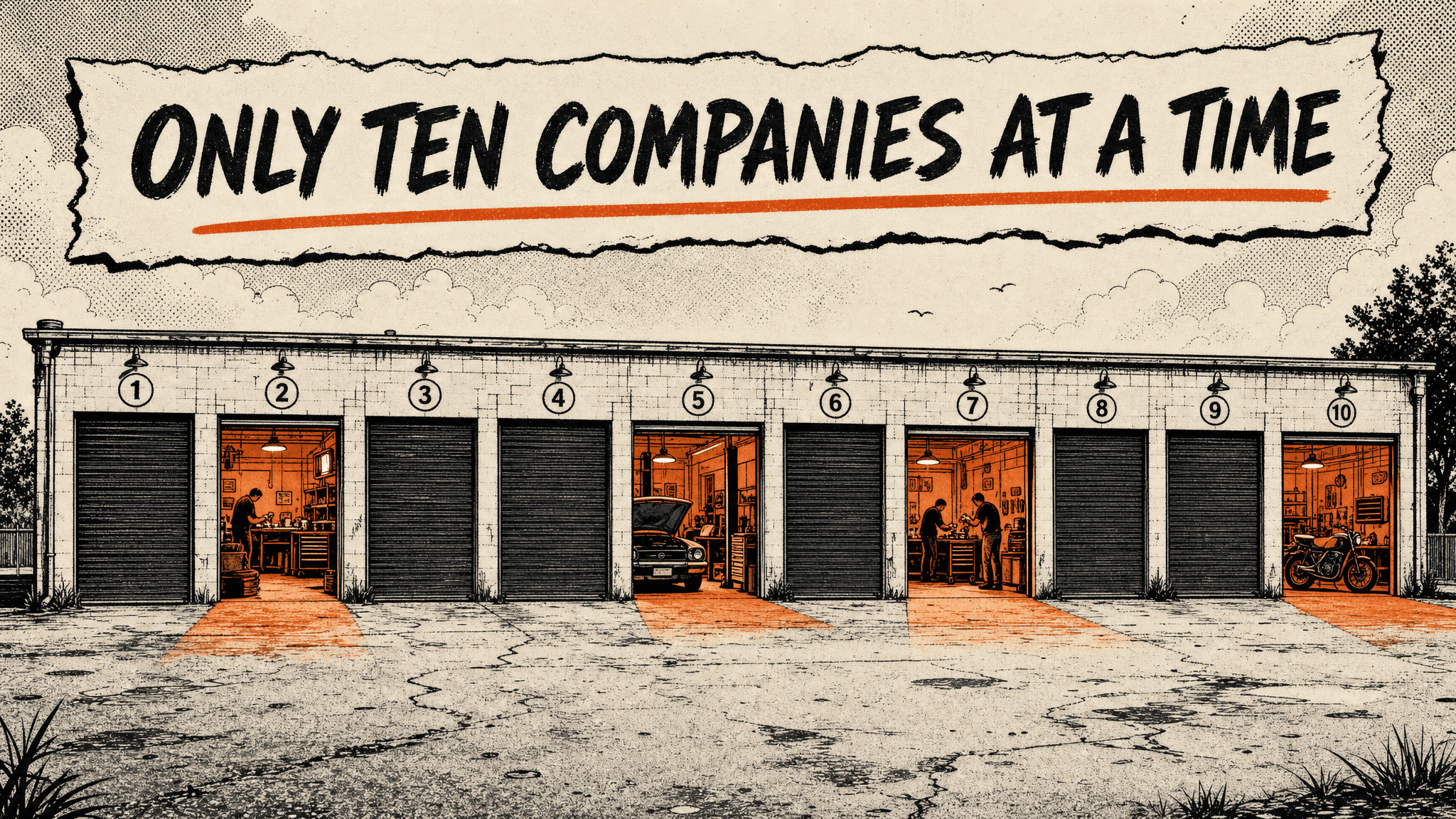
That arrangement now has a name and a cap. I take ten companies. This page shows you how it works, what it costs, and how to tell if your team is a fit.
Tom
Your company has probably "looked into AI" already. There's a ChatGPT subscription. Someone ran a lunch-and-learn. Maybe a consultant left a deck.
Six months later, the quoting is still manual. The reports still take someone's Friday. The onboarding doc still gets rebuilt from scratch every time.
That's not because your people aren't smart. It's because the two standard options both fail the same way.
Hire an agency, and you get a black box you rent. The day your process changes, you're back in their queue, paying again.
Send your team to a course, and the tutorials don't survive contact with your real data. Something works on Tuesday and breaks on Thursday, and there's nobody to ask.
Meanwhile the repetitive work compounds, every week, on your payroll.
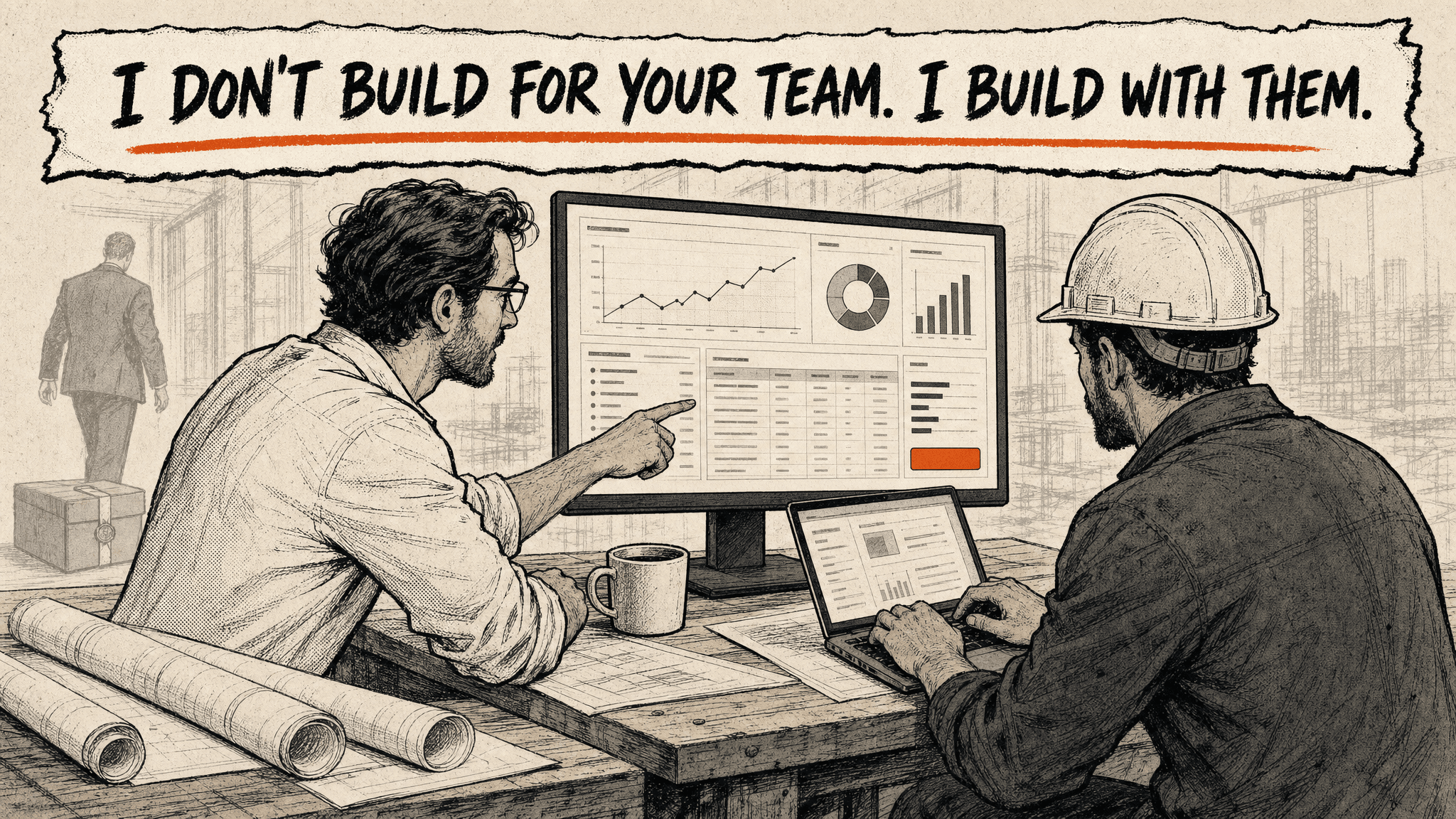
I build with your team, not instead of them. I architect, they build, and I speed run the process so they only spend time on the parts that actually need them.
Every month we get on build sessions with your team and their real workflows, on Claude Code, the same tool the AI labs use internally. The session isn't a lesson. It ends with something working in your business.
Between sessions, your team sends me what they're building and I send back exactly what to fix. They never sit stuck for a week, and I never become the bottleneck.
If I disappeared tomorrow, every system keeps running and your team can still change it. That's the difference between renting AI and owning it.
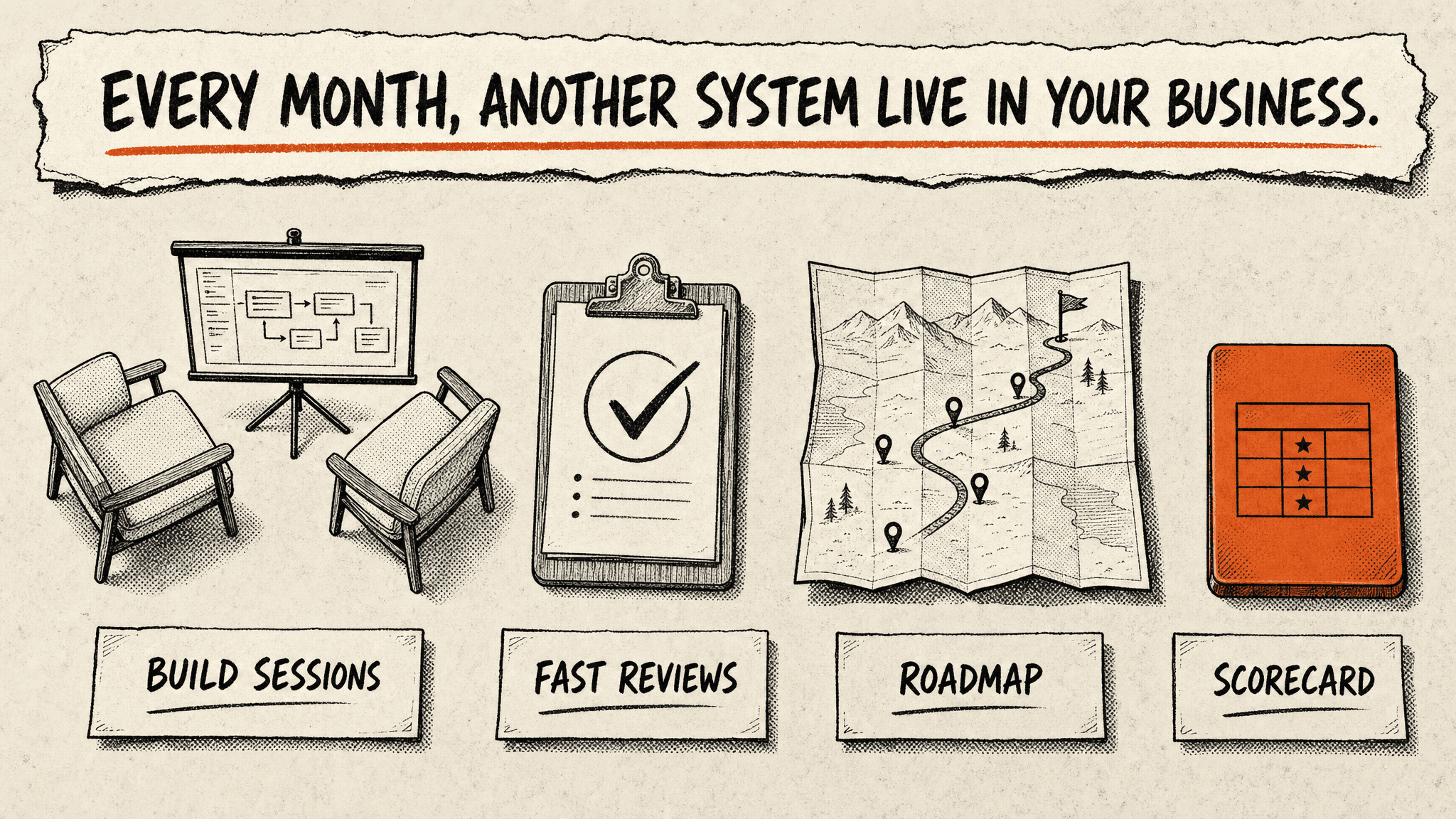
Every quarter you get one document: the systems your team shipped, the hours each one saves, and what those hours cost you in salary.
One client's team gave an admin back four to five hours a day. He's projecting six figures in year-one savings, and that number came off his scorecard, not a sales page.
If the number doesn't beat the retainer, you cancel. That's the deal, and it's in writing.
A 90-minute kickoff with you and your builders. We score your ten most repetitive processes, rank them by hours saved, and produce your AI Roadmap. Claude Code gets installed for everyone covered.
Your first build is scheduled before the kickoff call ends.
Team build sessions on your real workflows, each one ending with something live. Between sessions your team sends me their builds and I send back exactly what to fix, inside 48 hours.
Something new is working in your business every single month.
The scorecard: systems shipped, hours saved, and what those hours cost you in salary. The roadmap gets re-ranked and the next quarter's builds get picked from the top.
The renewal decision is made by a number, not a feeling.
…your team could have its first system live within the month.
"I just needed someone to tell me what to build first."
Gave an admin back 4-5 hours a day. Projecting six figures in year-one savings.

"I developed my workflows with no coding background at all. Manual entry would take days. Now it runs in the background in minutes."
29 documents automated. Then he put a team member through the same process.

"Probably for one of the first times in my life, I feel like I'm in control."
Shipped an end-to-end work order triage and dispatch system.
For teams getting their first systems live.
For teams making AI part of how the company runs.
Three-month minimum, then month to month. Your price is locked for 12 months from signing.
For context, my ad-hoc rate is $1,000 an hour, and clients pay it. The retainer exists because the businesses getting the most out of this don't need an hour, they need a cadence.

By the end of your first month, your team has at least one working system live in your business. Not a prototype, not a demo. Live and doing the work.
If it isn't, month two costs you nothing and we keep building until it is.
If you need to put this in front of a business partner or your leadership team, share this page. It covers everything they'd want to know.
I run every kickoff, every build session, and every review myself. That works at ten companies and falls apart at thirty, so I stop at ten.
When the calendar is full, this page says so and you go on a waitlist.
Book a thirty-minute discovery call. No application form, this one starts with a conversation.
Bring your three most repetitive processes. We sketch the first version of your roadmap on the call.
If we're a fit, your kickoff lands inside two weeks and your first build inside the month.
If we're not, I tell you on the call and point you at the cheaper path that actually fits.
Book a thirty-minute call. Bring your three most repetitive processes. Leave with a roadmap either way.
Book a Discovery CallTom
No, and that's deliberate. I architect, your team builds. Agencies hand you a black box that breaks the day your process changes. When your own people build the system, they can change it, fix it, and extend it without calling anyone. The capability stays on your payroll.
Your most operations-minded person, not your most technical one. Chris Cole's team member had zero coding background and his firm has now automated 29 documents. If someone on your team can write a clear email describing how a process works, they can build with Claude Code.
Claude Code plus the stack you already run (Airtable, Google Workspace, your CRM, whatever you use). Expect roughly $100 to $200 a month in software subscriptions, all on your own accounts. You own every account and every system from day one.
Everything is built on your accounts, inside your systems. Nothing sensitive passes through mine. At kickoff we agree data-handling rules for your business and they go in the roadmap doc, in writing.
Two to three focused hours a week per builder, including the sessions. The whole point is that the hours they put in come back multiplied. One client gave an admin back four to five hours a day from the systems his team built.
The intensive trains one person, usually the owner, over 90 days. The Embedded Architect embeds with your team month over month, on your company's systems, with a scorecard that tracks what it's saving you. Plenty of owners do the intensive first and then move their team onto this.
Three months, then month to month. Your price is locked for 12 months from signing. Every quarter you get the scorecard, hours saved times what those hours cost you, so the renewal decision is made by a number, not a feeling.
Yes. I run a two-hour live build workshop where I automate one of your team's real processes on the call and leave you a ranked roadmap of the next five. It's the fastest way to see how your team responds before committing. Ask me about it on the discovery call.