← Back to Blog
AI Statistics 2026: Adoption, Agents, and ROI.
The AI statistics that matter in 2026: adoption rates, AI agent deployment, ROI, barriers, and jobs, pulled from McKinsey, Stanford HAI, and Gartner.
The AI statistics that matter in 2026: adoption rates, AI agent deployment, ROI, barriers, and jobs, pulled from McKinsey, Stanford HAI, and Gartner.
AI statistics in 2026 tell a split story: adoption is now near-universal, but real financial return is still rare. As of 2025, 88% of organizations report regular AI use in at least one business function, yet only 39% can point to any measurable impact on earnings. That gap between using AI and profiting from it is the single most important number on this page.
I'm Tom Crawshaw. I run The AI Architects, and I spend my days helping founders and operators build their own AI automations with Claude Code. I pulled every statistic below from primary sources, McKinsey, Stanford HAI, Gartner, the US Federal Reserve, Anthropic, PwC, and Google, and linked each one so you can check it yourself. No aggregator listicles, no recycled numbers.
These are the figures journalists and analysts lead with in 2026. Each is drawn from a named primary source published in 2025 or 2026.
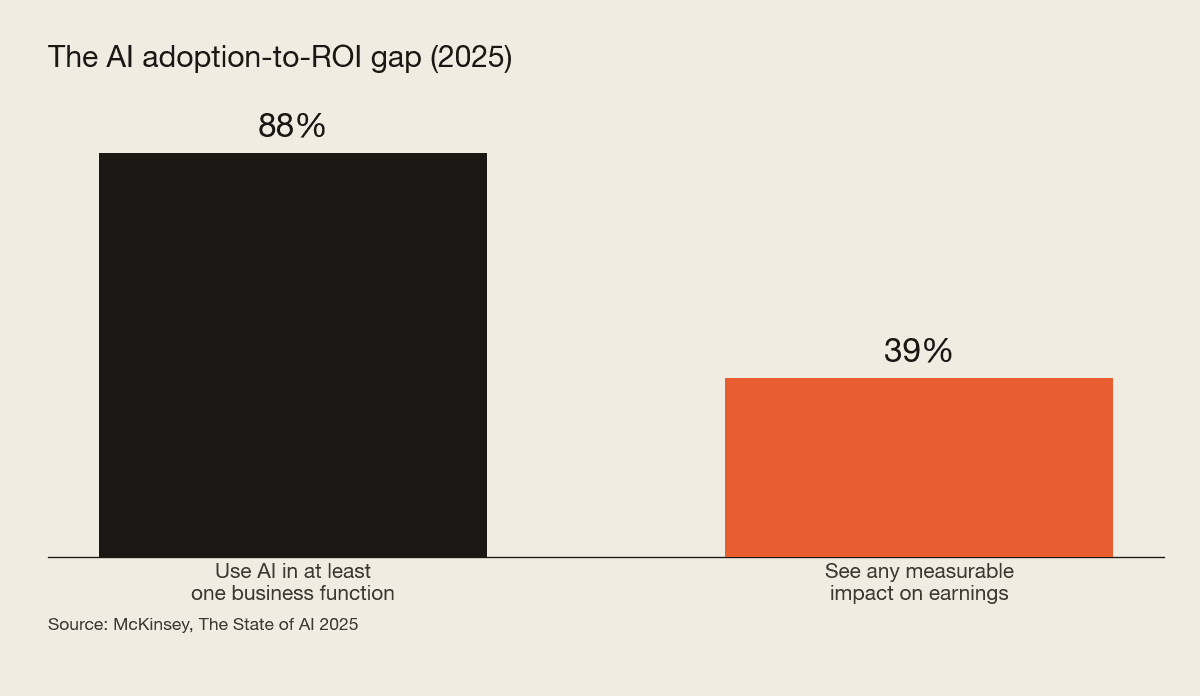
Most organizations now use AI, but most have not scaled it. McKinsey's 2025 State of AI survey of 1,993 respondents across 105 countries found 88% report regular AI use in at least one business function, up from 78% in 2024. Stanford's 2026 AI Index puts organizational adoption at the same 88% level, with generative AI specifically used in at least one function at 70% of organizations.
Scaling is where the picture thins out. Roughly one-third of organizations have begun to scale AI across the enterprise, and nearly two-thirds have not. More than two-thirds now use AI in more than one function, and half use it in three or more. Company size is the clearest divide: nearly half of companies with over $5 billion in revenue have reached the scaling phase, versus 29% of those under $100 million.
The official US numbers run lower than the survey numbers because they count firms, not enthusiasm. The US Federal Reserve reported about 18% of US firms had adopted AI by year-end 2025, while 78% of the labor force works at a firm that has adopted AI. Over 20% of US firms expect to use AI in the first half of 2026.
Small firms are closing the gap on large ones. US Census Bureau data, relayed through the SBA Office of Advocacy, shows small businesses under 250 employees using AI rose to 8.8% of firms, up from 6.3% six months earlier, against 11.1% for large firms. The size gap narrowed from a factor of 1.8. Oddly, businesses with fewer than five employees use AI more than other small firms, producing a U-shaped curve where the smallest and largest companies lead.
There is a catch in the small business data. About half of small firms using AI reported no investment in it at all, no training, no capital, no process change, versus 40% of large businesses. Adoption without investment is exactly the pattern that produces the ROI gap this page keeps returning to.
AI is being adopted faster than any prior general-purpose technology. Stanford HAI's 2026 AI Index found generative AI reached 53% population adoption within three years, outpacing both the personal computer and the internet at the same stage. Adoption correlates strongly with GDP per capita, so the curve is steepest in wealthy economies.
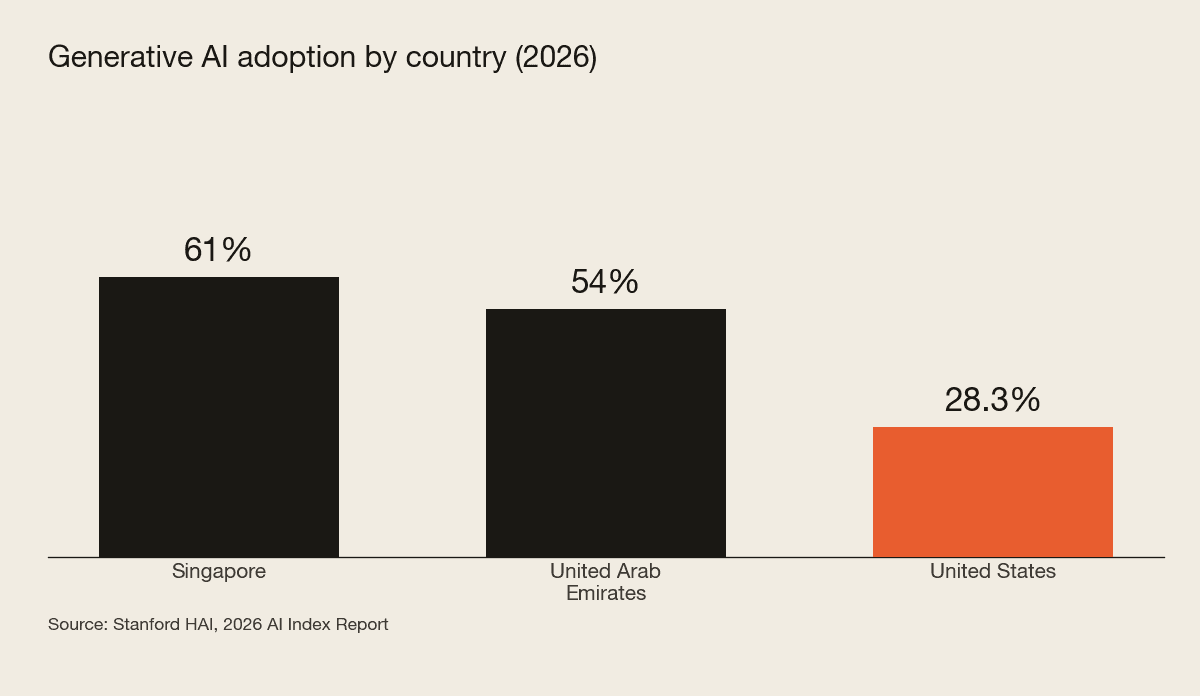
Country-level numbers show the spread. Generative AI adoption reaches 61% in Singapore and 54% in the United Arab Emirates, while the US ranks 24th at 28.3%. China and Europe posted the highest year-over-year increases in business use. On investment, the US dwarfs everyone: US private AI investment of $285.9 billion in 2025 was 23.1 times China's $12.4 billion.
The money tells the same growth story as the usage data. Corporate AI investment of $581.7 billion in 2025 represents a 130% jump in a single year. The estimated value of generative AI tools to US consumers reached $172 billion annually by early 2026, with median value per user tripling between 2025 and 2026.
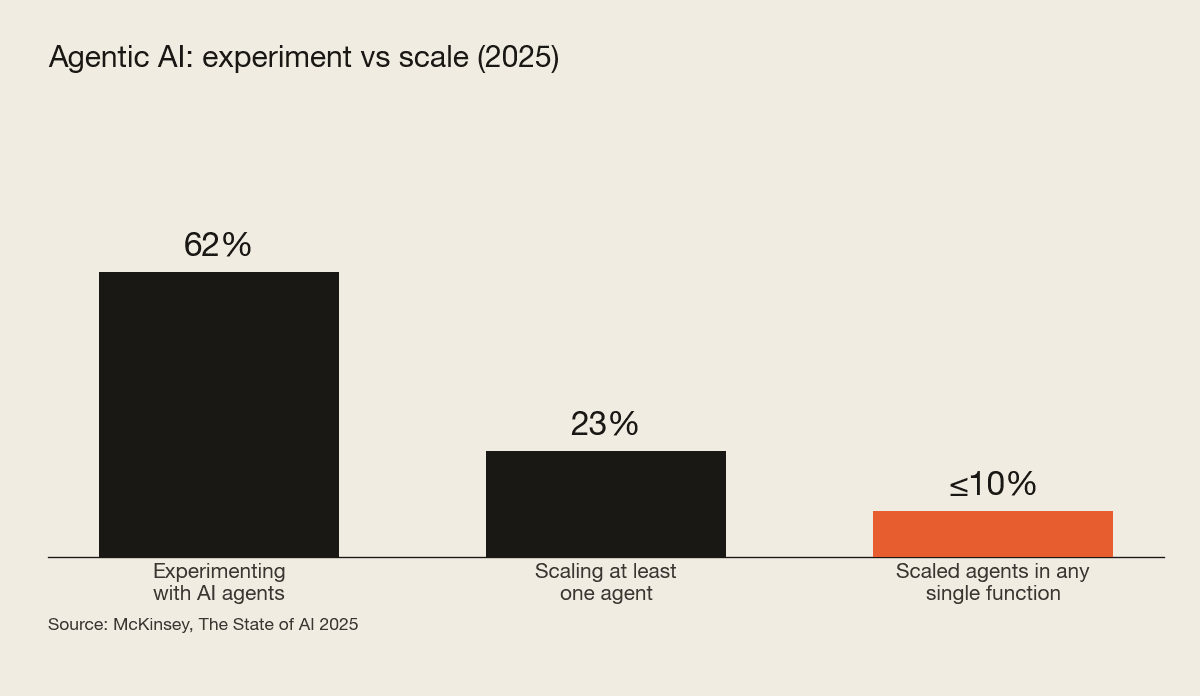
AI agents are widely tested and rarely scaled. McKinsey found 62% of organizations are at least experimenting with AI agents, with 23% scaling an agentic system in at least one function and another 39% experimenting. In any single business function, though, no more than 10% of organizations report scaling agents. Stanford HAI confirms agent deployment sat in the single digits across nearly every function in 2025.
The forecasts are aggressive and the failure rate is high at the same time. Gartner predicts that 40% of enterprise applications will include task-specific AI agents by the end of 2026, up from under 5% in 2025. Gartner also predicts that over 40% of agentic AI projects will be canceled by the end of 2027. In a January 2025 Gartner poll of 3,412 attendees, only 19% had made significant agentic investments. Gartner estimates just 130 of the thousands of self-described agentic vendors are real, calling the rest "agent washing."
Real usage data backs the build-versus-experiment split. Anthropic's Economic Index found 77% of business API usage follows an automation pattern, versus about 50% for consumer Claude.ai users. Conversations where users delegate a complete task to the model jumped from 27% to 39% over the report period. IBM reported 61% of CEOs are actively adopting AI agents and preparing to scale them.
Return on AI is concentrated in a small group of companies. McKinsey found only 39% of organizations attribute any EBIT impact to AI, and most of those put it under 5% of EBIT. A roughly 6% slice McKinsey calls "AI high performers" attribute at least 5% of EBIT to AI and are more than three times as likely to pursue transformative change. IBM's CEO study found only 25% of AI initiatives delivered the expected ROI in recent years, and just 16% scaled enterprise-wide.
The macro productivity data is more encouraging than the boardroom data. PwC's Global AI Jobs Barometer found productivity growth nearly quadrupled in the industries most exposed to AI, rising from 7% over 2018 to 2022 to 27% over 2018 to 2024. Those same industries saw three times higher growth in revenue per employee. Anthropic found college-level tasks run on Claude show an average 12x speedup.
Where the value lands depends on the function. McKinsey reports cost benefits show up most in software engineering, manufacturing, and IT, while revenue benefits cluster in marketing and sales, strategy and corporate finance, and product development. The 95% of pilots that fail and the 5% that succeed, a finding from MIT's NANDA report as reported by Fortune, come down to this: buying from specialized vendors succeeds about 67% of the time, while internal builds succeed about a third as often.
The barriers to AI value are operational, not technical. These are the failure modes the 2026 data points to, in order of how often they appear.
A reliability note matters here. AI agents handling real-world tasks improved to a 77.3% success rate on Terminal-Bench, up from 20% the year before (Stanford HAI). That is real progress and still well short of the reliability a business needs to hand over a critical workflow unattended.
AI is reshaping which skills get paid, more than it is eliminating jobs. PwC found jobs requiring AI skills carry a 56% average wage premium, up from 25% the prior year, and AI-skill job postings grew 7.5% even as total postings fell 11.3%. The skills employers want are changing 66% faster in AI-exposed occupations. Degree requirements are falling fastest in those same roles.
The workforce reductions are real but smaller than the headlines suggest. McKinsey found 32% of organizations expect headcount to fall by at least 3% from AI in the next year, while 43% expect no change and 13% expect increases. Across functions, a median 17% of organizations saw AI-driven workforce declines last year, rising to a median 30% expecting declines next year. The sharpest signal is at the entry level: Stanford HAI found employment among software developers aged 22 to 25 has fallen nearly 20% since 2024, even as headcount for older developers grew.
Leadership is the quiet variable in the data. McKinsey found AI high performers have senior leaders who are three times more likely to show strong ownership of AI initiatives. Gartner predicts that by 2029, at least half of knowledge workers will develop new skills to work with, govern, or create AI agents. The people who learn to build and direct automations are the ones the wage data rewards. That is the entire premise behind the Claude Code skills I teach.
AI automation shows up unevenly across business functions. Here is where the 2026 data concentrates, by function.
The data says the same thing I see in the field every week: tools are not the bottleneck, building is. Adoption is at 88% and ROI is at 39% because most companies bought access to AI and never built anything specific with it. The 5% of pilots that pay off, and the 6% of firms McKinsey calls high performers, are the ones who treated AI as something to build with, not subscribe to.
I have watched this play out client by client. One of my mentorship clients, Cal Hewitt, used Claude Code and n8n to build agentic work-order dispatch for a maintenance contractor. Acknowledgement time dropped from up to 48 hours down to minutes, and four months later he was introduced as the company's head of AI at a quarterly town hall. The full breakdown is in his case study. He is the 5%, not because he had better tools, but because he built a specific automation around a specific bottleneck.
That is the gap the statistics keep pointing at. If you want to be on the right side of the ROI number, the move is to build one real automation around one real problem, then expand. I wrote a step-by-step guide to Claude Code for exactly that, and if you are weighing your stack, my take on whether n8n is still worth it in 2026 covers where automation tools fit alongside AI agents.
88% of organizations report regular AI use in at least one business function as of 2025, according to McKinsey, up from 78% a year earlier. Official US firm-level data from the Federal Reserve is lower, at about 18% of firms, because it counts formal adoption rather than any use.
Roughly 95% of enterprise generative AI pilots show little or no measurable profit-and-loss impact, per MIT's NANDA report. Separately, Gartner predicts over 40% of agentic AI projects will be canceled by the end of 2027 due to cost, unclear value, or weak risk controls.
Only 39% of organizations attribute any EBIT impact to AI, and most of those say it is under 5%, according to McKinsey. Returns concentrate in a small group: the 6% of firms McKinsey calls high performers attribute at least 5% of EBIT to AI.
Yes, but mostly at the experimental stage. McKinsey found 62% of organizations are experimenting with AI agents and 23% are scaling at least one, while no more than 10% have scaled agents in any single function. Gartner expects 40% of enterprise apps to include task-specific agents by the end of 2026.
Singapore leads on generative AI adoption at 61%, followed by the United Arab Emirates at 54%, per Stanford HAI's 2026 AI Index. The US ranks 24th at 28.3% but dominates investment, with $285.9 billion in private AI investment in 2025.
AI is reshaping pay more than cutting headcount overall. McKinsey found 32% of organizations expect at least a 3% headcount reduction from AI next year, while jobs requiring AI skills carry a 56% wage premium, per PwC. The clearest decline is among entry-level software developers aged 22 to 25, down nearly 20% since 2024.
Generative AI reached 53% population adoption within three years, faster than the personal computer or the internet at the same stage, according to Stanford HAI's 2026 AI Index.
The statistics make the path obvious. The companies getting return are the ones building specific automations, not buying generic access. If you want to join them, my free Claude Code Blueprint walks you through your first build in 60 minutes with no coding, and the 30-day challenge takes you from there to a working operator stack.
Five interactive lessons. Install Claude Code, build your first automation, and deploy it live on the internet — all in under an hour. Free, no coding required.
Grab the Blueprint →