← Back to Blog
How to Succeed in AI Without Grinding 24/7.
You don't need to grind 17-hour days to succeed in AI. The people winning are not the ones working the most hours. They are the ones using leverage.
You don't need to grind 17-hour days to succeed in AI. The people winning are not the ones working the most hours. They are the ones using leverage.
You do not need to grind 24/7 to succeed in AI. The people who actually win in this space are not the ones putting in 17-hour days. They are the ones building the right systems, finding the right problems, and using leverage to multiply every hour they do work.
I am Tom. I have been in the automation and AI space for years, and I have done the chronically online, 14-hour-a-day version of this game. I burned out. I want to walk you through what I actually believe works, why grinding is a trap, and the calmer path most creators will not tell you about because it does not sell coaching programs.
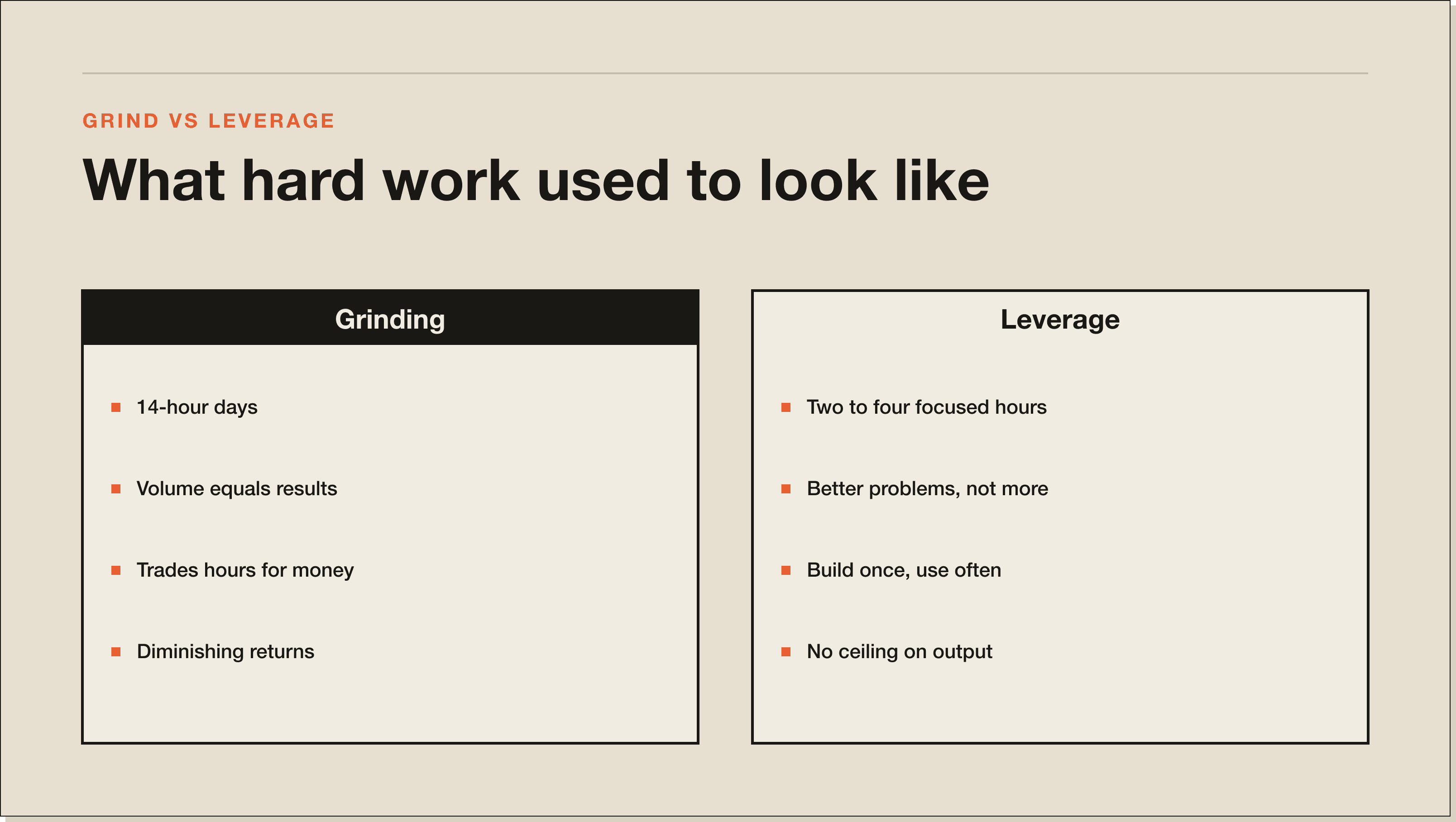
No. You do not need to grind 24/7 to learn AI or to build a career in it. Hours do not equal money. Volume does not equal results. The single most expensive lie sold in the AI space right now is that you have to outwork everyone else to make it.
In the video below I lay out the case directly. It is not a tutorial. It is a position piece on what hustle culture is actually doing to your output, and what the alternative looks like.
Every creator, every guru telling you to wake up at 4 a.m. to grind it out all day, they only want you to believe one thing. That the only way to make it in AI is to outwork everyone else. And I am here to tell you that is complete nonsense.
That is straight out of the video. I stand behind every word of it. The AI tools you are using exist precisely so you do not have to throw raw hours at every problem. Using leverage tools and then ignoring the leverage they give you is the most common mistake I see new builders make.
You wake up at 5 a.m., open X first thing, see a 19-year-old posting a 100K screenshot, and feel that pit drop in your stomach. You have been doing 14-hour days. You are vibe coding five different apps a week. None of it is making any money. You feel guilty closing the laptop. You feel guilty sleeping eight hours. You feel guilty seeing friends.
That feeling is not a sign you are behind. It is a sign the loop you are in is broken. I have been in it. I know exactly what it feels like. And I want to tell you what is actually happening underneath it.
When you sustain low sleep over months, your cognitive function tanks. You will not feel it because you normalize it. But if you tested current-you against eight-to-nine-hours-of-sleep-you, the gap would be embarrassing. There is real science on this. Matthew Walker's work in Why We Sleep lays out the cognitive cost of sleep debt in clinical detail. You cannot out-grind biology.
If you start throwing hours at a problem, you are going to be thinking that volume equals results when that is really not the case. You will eventually hit diminishing returns.
Then there is the comparison trap. If you are making a few grand a month, the goal is 10K. Hit 10K, the goal becomes 50K. Hit 50K, it becomes 100K. Nothing is ever enough. When your identity is welded to that number, a single bad month or one unexpected expense can destroy you. I have invested heavily in mentors and programs over the years. Some hit, some did not. The bank account is not a stable place to store your self-worth.
Long enough that grinding 17 hours a day for two weeks will not get you there, and short enough that you do not need to ruin your health for it. In my experience, three to four focused hours a day across three to six months is enough to go from beginner to building real workflows that solve real problems. The bottleneck is not raw time. It is the quality of the problems you point your hours at.
In Deep Work, Cal Newport argues that nobody can do real cognitive work for more than around four hours a day. He himself does two two-hour deep blocks and stops. That is the ceiling, not because he is lazy, but because that is how human focus works. Anything past that is busywork dressed up in a Pomodoro timer.
So when somebody tells you they are putting in 17-hour days to learn AI, two things are usually true. They are lying about the hours, or they are doing four hours of work and 13 hours of low-grade scrolling, refactoring, and tab-switching that feels productive.
You pick one tool, one problem, and one outcome. You spend two to four focused hours a day on it. You go to bed on time. You see your friends. You let ideas percolate while you walk, train, cook, or sleep. The percolation is where the high-leverage decisions actually come from. You cannot solve a problem you have stared at for ten hours straight. You can solve it after a night of sleep and a coffee.
Naval Ravikant has the cleanest framing for this. The corner shop owner works as hard, often harder, than the tech CEO. The difference is not effort. It is leverage. The shop owner trades hours for money. The CEO uses code, capital, and media to decouple earnings from hours. Same effort, different tools. You can read his How to Get Rich series for the long version. To succeed in AI, you want to be on the leverage side of that equation, not the hours side.
Output equals volume times leverage. Time has a ceiling, but your leverage does not. So focus on the one without a ceiling.
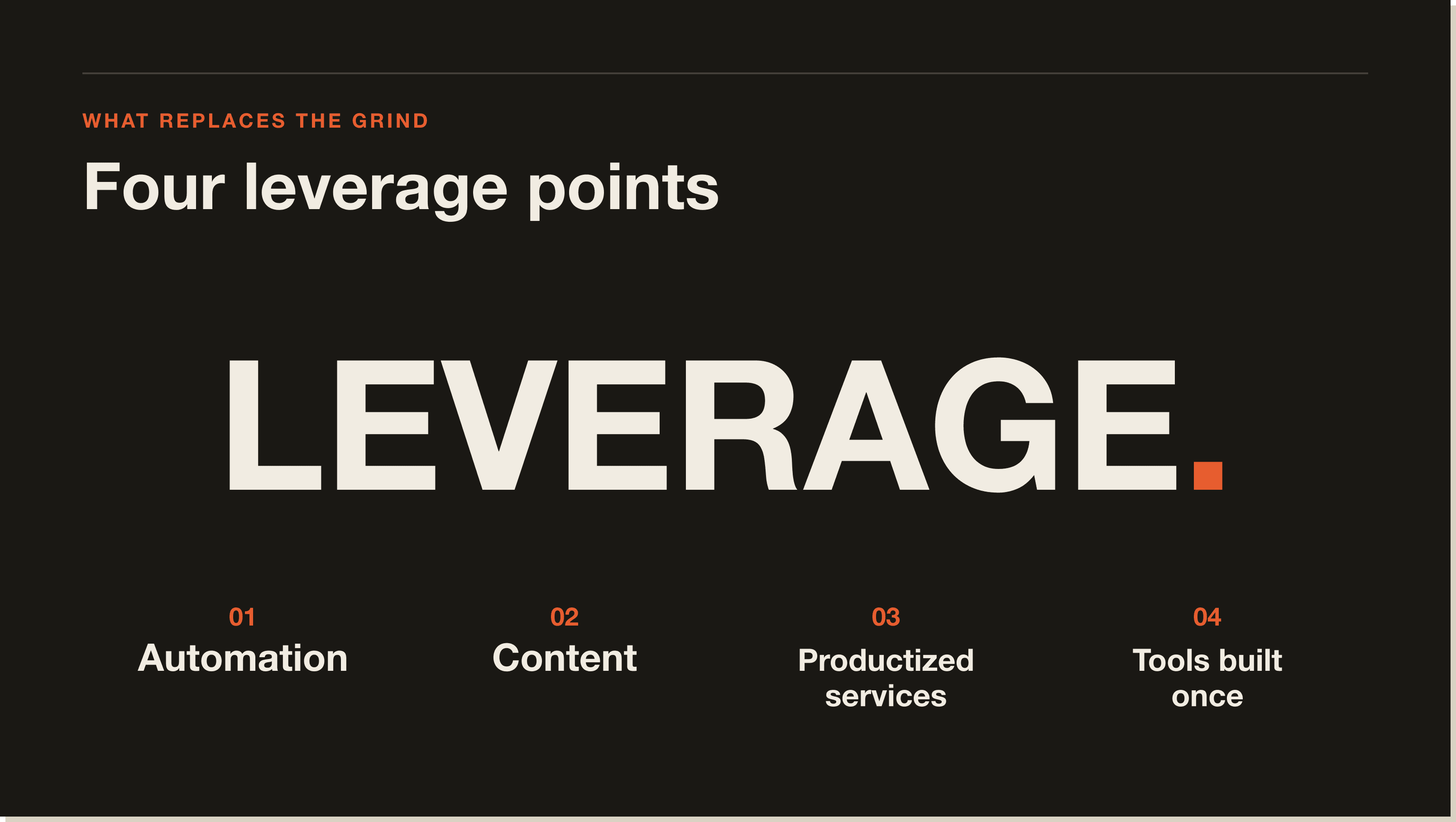
Practically, that means automation, content, productized services, and tools you build once and sell or use a hundred times. It does not mean five-app-a-day vibe coding sprints that never ship.
I do believe in seasons. There are weeks where I am in a sprint and the hours are long. That is fine when it is bounded and pointed at a clear goal. The danger is when the sprint becomes the lifestyle. Bounded sprints, then real recovery. That is the rhythm. Watch how an athlete trains. Nobody is in race condition all 52 weeks.
And do not underestimate the social cost. Grinders are isolated. The only human contact most of them get is via screen, which is mostly other people performing fake versions of themselves. I do West Coast Swing twice a week. Hugging, high-fiving, being physically near other humans. That is not a luxury. That is required hardware for a working brain.
My honest position. Grinding 17 hours a day to succeed in AI is not the smart move. It is the lazy one. It is easier to throw raw hours at a problem than to sit still and figure out which problem is actually worth solving. The lazy option looks productive. It is not.
This path is for you if you want freedom, time with the people you care about, and a working body and brain at age 60. It is not for you if you want to be the next Elon Musk and you are willing to torch every relationship and organ in your body to get there. Both are valid choices. Pick one with your eyes open.
For everyone else, the answer is the same. Fewer hours. Better problems. More leverage. More sleep. More humans.
No. The people who win in AI are not the ones with the most hours logged. They are the ones who pick the right problem, build the right system once, and use leverage to scale the output. Volume of hours hits diminishing returns fast. Leverage does not.
Three to six months of focused, three-to-four-hour daily work is enough for most people to go from zero to building real workflows that solve real problems. The bottleneck is not the hours. It is whether the problem you are solving actually matters.
Yes. AI burnout is the same shape as any other knowledge-work burnout, but it gets accelerated by hyper-online culture and the constant feeling that a new tool is dropping every 12 hours. Sleep loss, social isolation, and identity tied to revenue screenshots are the three biggest accelerants. Cap your hours, defend your sleep, and stop measuring yourself against curated X feeds.
One tool, one problem, one outcome at a time. Two to four focused hours a day. Eight hours of sleep. Real human contact. Bounded sprints when you need to push, real recovery when you do not. Build leverage assets like automations, content, and small products instead of trading raw hours for raw cash.
Most of the revenue screenshots you see online are either fake, cherry-picked, or attached to a much darker private life than the post implies. Treat the timeline as entertainment, not as a benchmark. Run your own race against your own numbers from last month. That is the only honest comparison.
Yes, in almost every case. Real cognitive work needs recovery. The good ideas surface in the gaps, not in hour 14 of staring at a screen. Take the weekends. See people. Move your body. Come back Monday with a clearer brain and you will out-ship the seven-day grinder every time.
If this guide was useful, these go deeper on adjacent topics:
Primary sources referenced in this guide:
If you want the leverage path, start with the Claude Code Blueprint. It is a free 60-minute walkthrough that shows you how to build your first real automation without writing code. If you want the structured version, the 30-Day Claude Code Challenge runs once a month and is built around the exact opposite of grind culture. Three to four focused hours a day, real outputs, no all-nighters. If you want to see what one of these systems looks like in practice, my Paperclip AI review walks through how I run an autonomous AI team without sitting at the keyboard for 17 hours a day.
Five interactive lessons. Install Claude Code, build your first automation, and deploy it live on the internet — all in under an hour. Free, no coding required.
Grab the Blueprint →