← Back to Blog
Claude Code Pricing 2026: Pro, Max, Team and API.
Claude Code pricing for Pro, Max, Team and API. Compare the current plan costs, usage limits and the right tier for daily work.
Claude Code pricing for Pro, Max, Team and API. Compare the current plan costs, usage limits and the right tier for daily work.
The Fable 5 promotion described in older versions of this article has ended. Do not use its former eligibility, cap or pricing claims to choose a plan. Check Anthropic's current pricing and model documentation for present model access.
I'm Tom. I run Claude Code on Max 5x most days and have stress-tested API billing for bursty agent work. I've also lived through the April 2026 pricing scare, when Anthropic briefly removed Claude Code from Pro for a slice of users before reversing the decision. This post is the version of pricing I wish someone had handed me before I made the wrong choice twice. Specific numbers, real receipts, and a calculator to help you pick a plan instead of guessing.
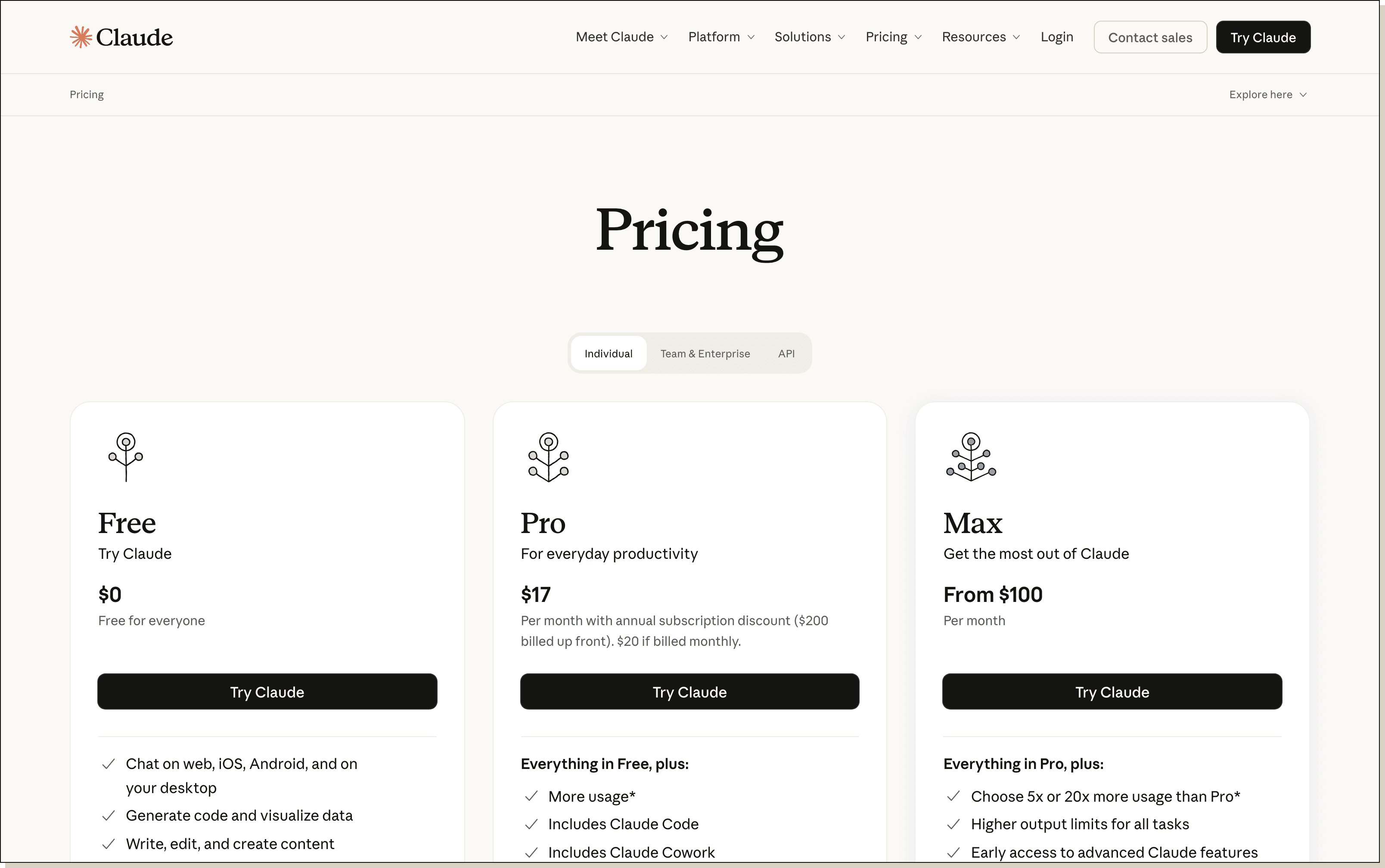
Claude Code costs $0 to install and from $20 a month to use seriously. Pro costs $20 monthly or $200 annually. Max 5x costs $100 monthly and Max 20x costs $200 monthly. Team starts at $25 per Standard seat monthly, or $20 with annual billing, and requires at least five seats. There is no separate Claude Code licence. You pay for a Claude plan or use API billing.
Here is the at-a-glance table I keep in my notes.
Free: $0. Limited Claude chat and coding assistance, but no included Claude Code plan access. Pro is the realistic starting point for the CLI.
The Fable 5 promotion described in older versions of this article has ended. Do not use its former eligibility, cap or pricing claims to choose a plan. Check Anthropic's current pricing and model documentation for present model access.
The Fable 5 promotion described in older versions of this article has ended. Do not use its former eligibility, cap or pricing claims to choose a plan. Check Anthropic's current pricing and model documentation for present model access.
Max 20x: $200 a month. It includes roughly twenty times Pro's usage per session and is built for long daily sessions, parallel agents, and heavier Claude Code workloads.
Team Standard: $25 per seat monthly or $20 per seat with annual billing. Team Premium: $125 monthly or $100 annually. Team requires five to 150 seats, and organizations can mix Standard and Premium seats.
Enterprise: $20 per seat plus model usage billed at API rates on the current self-serve plan. Sales-assisted contracts can add custom procurement, security, and support terms.
The Fable 5 promotion described in older versions of this article has ended. Do not use its former eligibility, cap or pricing claims to choose a plan. Check Anthropic's current pricing and model documentation for present model access.
The Fable 5 promotion described in older versions of this article has ended. Do not use its former eligibility, cap or pricing claims to choose a plan. Check Anthropic's current pricing and model documentation for present model access.
The Fable 5 promotion described in older versions of this article has ended. Do not use its former eligibility, cap or pricing claims to choose a plan. Check Anthropic's current pricing and model documentation for present model access.
The Fable 5 promotion described in older versions of this article has ended. Do not use its former eligibility, cap or pricing claims to choose a plan. Check Anthropic's current pricing and model documentation for present model access.
The Fable 5 promotion described in older versions of this article has ended. Do not use its former eligibility, cap or pricing claims to choose a plan. Check Anthropic's current pricing and model documentation for present model access.The Fable 5 promotion described in older versions of this article has ended. Do not use its former eligibility, cap or pricing claims to choose a plan. Check Anthropic's current pricing and model documentation for present model access.The Fable 5 promotion described in older versions of this article has ended. Do not use its former eligibility, cap or pricing claims to choose a plan. Check Anthropic's current pricing and model documentation for present model access.
The Fable 5 promotion described in older versions of this article has ended. Do not use its former eligibility, cap or pricing claims to choose a plan. Check Anthropic's current pricing and model documentation for present model access.
The Fable 5 promotion described in older versions of this article has ended. Do not use its former eligibility, cap or pricing claims to choose a plan. Check Anthropic's current pricing and model documentation for present model access.
Claude Max comes in two flavours. Max 5x is $100 a month and gives you roughly five times Pro's usage per session. Max 20x is $200 a month and gives you roughly twenty times Pro's usage per session. Both add higher output limits, priority access during busy periods, and early access to advanced Claude features. The $100 jump from Pro to Max 5x is the useful upgrade for daily Claude Code work. Max 20x is for people running agent teams or multi-hour parallel sessions.
Use this decision matrix to pick a plan in under a minute. The useful questions are how often you run Claude Code, how quickly you hit the included limits, and how expensive an interrupted build feels to you.
Curious tinkerer, under five hours a week, mostly content and one-off scripts: Free or Pro. Pro is the right answer if you want to actually finish anything.
Solo builder, five to fifteen hours a week, building real projects: Pro if you can stay inside the regular allowance, Max 5x if you keep hitting it. I recommend Max 5x to almost everyone in this bracket because losing momentum mid-build usually costs more than the $80 difference.
Daily operator, fifteen to thirty hours a week, agent teams and parallel sessions: Max 5x for most weeks, Max 20x if you regularly hit the higher limit. This is where I sit. Max 5x covers most weeks, and I lower effort before paying for capacity I will not use every month.
Hardcore agent team, thirty plus hours a week, running Claude Code on the web and in the terminal in parallel, building products: Max 20x. Below that, you will hit the cap on Tuesday afternoon and spend the rest of the week regretting it.
Team of five to 150 people sharing one bill: Team Standard at $25 per seat monthly or $20 annually. Premium costs $125 monthly or $100 annually and gives power users more capacity. You can mix seat types while keeping one invoice, SSO, and central administration.
Bursty workloads with quiet weeks: API. If you run hot for three days then go quiet for ten, pay-as-you-go on the API often beats any subscription. Build a small budget alarm into your dashboard and you will not get caught out.
Yes for daily Claude Code users, no for casual ones. Max 5x at $100 a month is worth it when Pro interrupts normal work. Max 20x at $200 is worth it when you run parallel agents, long sessions, or product work that regularly exhausts Max 5x. If you are still testing Claude Code, start on Pro and upgrade when the usage screen gives you a reason.
Here is the test I use. Open /usage in Claude Code on a normal week. If you are above 60% of your weekly cap by Wednesday, Max 5x will pay for itself in saved time. If you are above 80% of Max 5x's cap by Wednesday, Max 20x will pay for itself in saved time. The math is rarely about the dollars. It is about the cost of stopping mid-build because the agent ran out of room.
Only if you are billing Claude Code through the API. By default, Claude Code uses your subscription quota (Pro, Max, Team), not your API credit balance. If you log in with claude login on a Pro or Max account, every token comes out of your weekly subscription cap. If you set ANTHROPIC_API_KEY in your shell or run claude login --api, every token comes out of your API credit balance instead.
This trips up almost everyone the first time. You buy $50 of API credit, never set the env var, and wonder why your balance never moves. The credit only burns when you tell Claude Code to use it. Run claude config get authMode to check which mode you are in. The two valid values are subscription and api.
The Fable 5 promotion described in older versions of this article has ended. Do not use its former eligibility, cap or pricing claims to choose a plan. Check Anthropic's current pricing and model documentation for present model access.
Claude also applies session limits that normally reset every five hours. If you reach an included limit, Claude does not silently bill your card. You can wait for the reset, switch models where available, upgrade your plan, or use separately billed usage credits if you have enabled them.
Effort does not cost extra dollars on a subscription. It costs tokens against your weekly cap. The /effort command lets you set the level for the current session: low, medium, high, xhigh, or max. Higher effort means more extended thinking on every turn, which means more tokens per response, which means you hit the cap faster. On API billing, higher effort directly increases your per-turn token spend.
The Fable 5 promotion described in older versions of this article has ended. Do not use its former eligibility, cap or pricing claims to choose a plan. Check Anthropic's current pricing and model documentation for present model access.
Two steps. Buy a Pro or Max subscription on claude.com, then change your auth mode in the CLI. Open Claude Code, run /logout, then /login, and pick the subscription option when prompted. The CLI swaps from API to subscription billing immediately. Any unused API credits stay on your account and do not expire for twelve months.
If you want to make the switch programmatic, set the env var explicitly. CLAUDE_AUTH_MODE=subscription in your shell will pin Claude Code to your subscription regardless of the API key in your environment. Drop that into your .zshrc or .bashrc and you will never burn credits by accident again.
The Fable 5 promotion described in older versions of this article has ended. Do not use its former eligibility, cap or pricing claims to choose a plan. Check Anthropic's current pricing and model documentation for present model access.
Most people regret going to Max too late, not too early. The reason is that Pro's cap is generous on paper but feels small the moment you start running agents in the background or kicking off plan mode on a real refactor. The first week you hit the cap mid-build and wait two days for it to reset, you will know it is time to upgrade.
At the same tier, they are basically identical. Pro is $20 against Cursor Pro at $20. Max 20x is $200 against Cursor Ultra at $200. Cursor has a $60 Pro+ tier with no Claude Code equivalent, and Claude has Max 5x at $100 with no Cursor equivalent. The decision is not price. It is what each tool actually does, which I cover in the deep comparison below.
If you are deciding between the two, my full Claude Code vs Cursor breakdown walks through twelve real projects in both tools. The short version: Claude Code wins on agentic work, Cursor wins on inline autocomplete, and the smart move is to run them together for $40 a month total at the entry tier.
In April 2026, Anthropic ran a quiet test that removed Claude Code from the Pro tier for about 2% of users. The Register covered the change within hours of users noticing. The pushback was loud, and Anthropic reversed it inside a week. If you saw the news and assumed Pro no longer covers Claude Code, that was true for a sliver of users for a few days, and is no longer true for anyone.
The bigger lesson is that pricing here is still being calibrated. Anthropic ships Claude Code on subscription billing as a strategic bet, not a profit centre. They want serious builders inside the surface and will move tiers around to find the right line. Plan for one to two pricing changes a year and it will not catch you off guard.
Pro at $20 if you are starting out and want to test Claude Code on real work for a month before committing. Max 5x at $100 if Claude Code is in your daily stack. Max 20x at $200 if it is your primary surface for shipping software. Team if you are three or more devs sharing one bill. Enterprise if you have an IT team negotiating contracts. API if your usage is bursty enough that a flat monthly subscription does not fit.
The Fable 5 promotion described in older versions of this article has ended. Do not use its former eligibility, cap or pricing claims to choose a plan. Check Anthropic's current pricing and model documentation for present model access.
The Claude Code CLI is free to install. Real usage requires a Claude account, and the free tier on Claude is too capped to do meaningful work. Pro at $20 a month is the realistic floor. The full breakdown of what "free" actually gets you lives in my deep dive on whether Claude Code is free.
The Fable 5 promotion described in older versions of this article has ended. Do not use its former eligibility, cap or pricing claims to choose a plan. Check Anthropic's current pricing and model documentation for present model access.
The Fable 5 promotion described in older versions of this article has ended. Do not use its former eligibility, cap or pricing claims to choose a plan. Check Anthropic's current pricing and model documentation for present model access.
Anthropic does not currently offer a standing individual student discount for Pro or Max. Universities can buy the separate Claude for Education plan, and Anthropic occasionally runs limited promotions. Check the official pricing page rather than relying on old discount posts.
Pro is a flat monthly subscription with a weekly usage cap. The API is pay-per-token with no cap. Pro is cheaper for steady daily use. The API is cheaper for bursty workloads. Both run the same Claude models. The difference is billing, not capability.
The Fable 5 promotion described in older versions of this article has ended. Do not use its former eligibility, cap or pricing claims to choose a plan. Check Anthropic's current pricing and model documentation for present model access.
Cursor Ultra is $200 a month with roughly 20x Cursor Pro's usage. Claude Code Max 20x is $200 a month with roughly 20x Pro's usage. The headline price is identical. The difference is the tool around the model. Cursor Ultra is an AI-first IDE. Claude Code Max 20x is a multi-surface agent that runs in your terminal, IDE, desktop, browser, and phone.
For teams of five to 150 people, Team is the right starting point. Standard seats cost $25 monthly or $20 with annual billing. Premium seats cost $125 monthly or $100 annually and provide more usage. Organizations can mix the two seat types.
Almost certainly. Anthropic adjusted pricing twice in the last year, ran the Pro test in April, and is still calibrating where Claude Code sits in the lineup. Plan for one or two changes a year and check the pricing page when something feels off. The CLI itself does not change. The plan tiers around it do.
If this guide was useful, these go deeper on adjacent topics:
Primary sources referenced in this guide:
The Fable 5 promotion described in older versions of this article has ended. Do not use its former eligibility, cap or pricing claims to choose a plan. Check Anthropic's current pricing and model documentation for present model access.
The Fable 5 promotion described in older versions of this article has ended. Do not use its former eligibility, cap or pricing claims to choose a plan. Check Anthropic's current pricing and model documentation for present model access.
Pricing is the easy part. Picking a plan takes ten minutes. Actually using Claude Code well takes a weekend. The fastest way in is the free Claude Code Blueprint. Sixty minutes, no coding required, and you walk out with a working setup, your first build, and a clean answer to which tier fits your workflow. If you want a longer reference for the tool itself, the complete Claude Code guide covers every concept the pricing page assumes you already know.
If you want the version where you actually ship something in a month, the 30-Day Claude Code Challenge is the cohort. Four live calls, a real build per week, and a deployed agent on a real schedule by the end. By the time you are done, you will know your real Claude Code bill, your real plan, and your real workflow. Not the hypothetical version on a comparison post.
The Fable 5 promotion described in older versions of this article has ended. Do not use its former eligibility, cap or pricing claims to choose a plan. Check Anthropic's current pricing and model documentation for present model access.
Claude Code costs $0 to install and from $20 a month to use seriously. Pro costs $20 monthly or $200 annually. Max 5x costs $100 monthly and Max 20x costs $200 monthly. Team starts at $25 per Standard seat monthly, or $20 with annual billing, and requires at least five seats. There is no separate Claude Code licence. You pay for a Claude plan or use API billing.
The Fable 5 promotion described in older versions of this article has ended. Do not use its former eligibility, cap or pricing claims to choose a plan. Check Anthropic's current pricing and model documentation for present model access.
The Fable 5 promotion described in older versions of this article has ended. Do not use its former eligibility, cap or pricing claims to choose a plan. Check Anthropic's current pricing and model documentation for present model access.
The Fable 5 promotion described in older versions of this article has ended. Do not use its former eligibility, cap or pricing claims to choose a plan. Check Anthropic's current pricing and model documentation for present model access.
Only if you are billing Claude Code through the API. By default, Claude Code uses your subscription quota (Pro, Max, Team), not your API credit balance. If you log in with claude login on a Pro or Max account, every token comes out of your weekly cap. If you set ANTHROPIC_API_KEY in your shell or run claude login --api, tokens come out of your API balance. Run claude config get authMode to check which mode you are in.
At the same tier, basically identical. Pro is $20 against Cursor Pro at $20. Max 20x is $200 against Cursor Ultra at $200. Cursor has a $60 Pro+ tier with no Claude Code equivalent, and Claude has Max 5x at $100 with no Cursor equivalent. The decision is not price, it is what each tool does. Claude Code wins on agentic work. Cursor wins on inline autocomplete. The smart move is to run them together for $40 a month at the entry tier.
The Fable 5 promotion described in older versions of this article has ended. Do not use its former eligibility, cap or pricing claims to choose a plan. Check Anthropic's current pricing and model documentation for present model access.
Five interactive lessons. Install Claude Code, build your first automation, and deploy it live on the internet — all in under an hour. Free, no coding required.
Grab the Blueprint →