← Back to Blog
Claude 4 models (Opus, Sonnet, Haiku): which for which job.
Opus 4.7, Sonnet 4.6, Haiku 4.5: three models, three jobs. The pricing crossover points, version numbering explained, and the default setup I use in Claude Code daily.
Opus 4.7, Sonnet 4.6, Haiku 4.5: three models, three jobs. The pricing crossover points, version numbering explained, and the default setup I use in Claude Code daily.
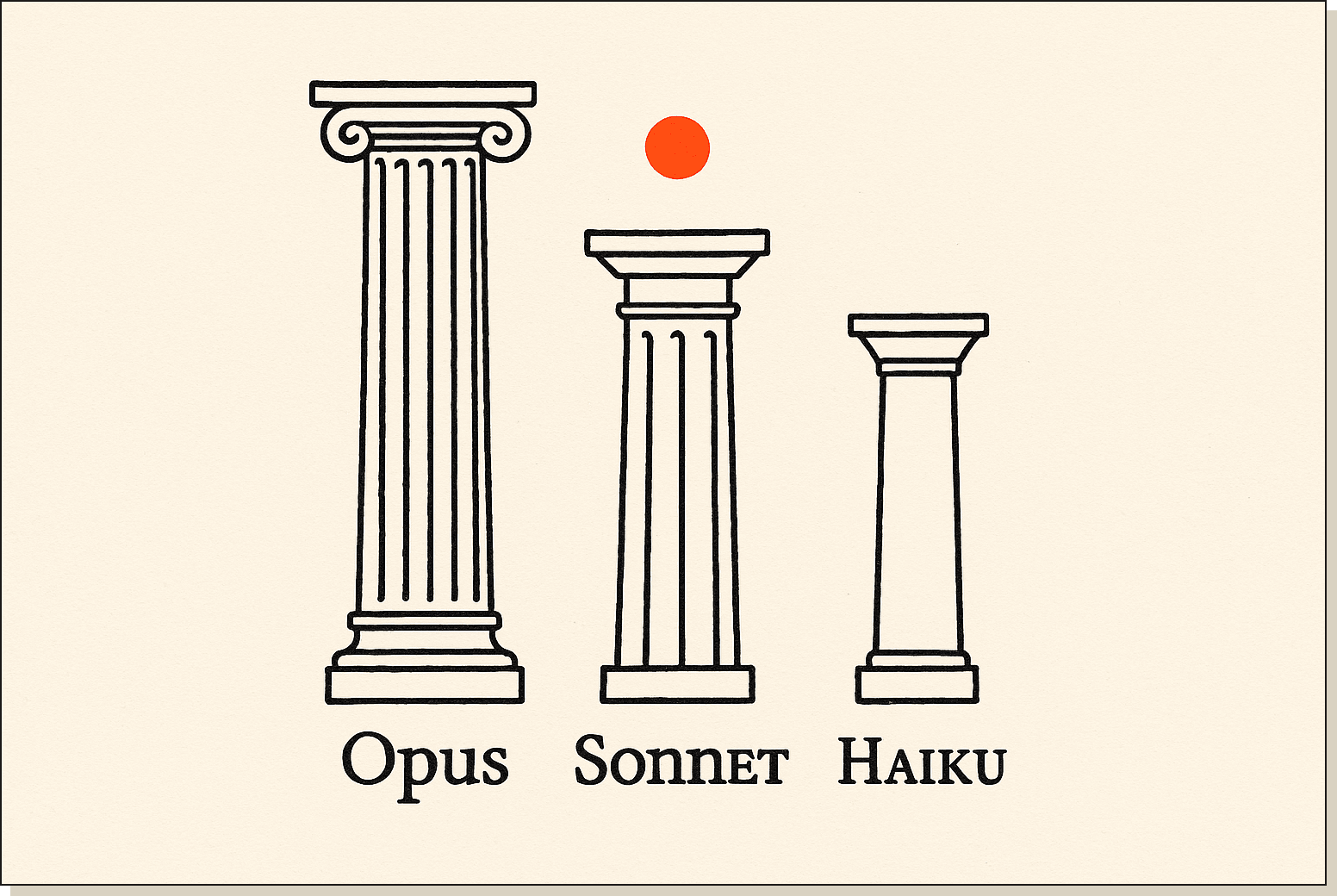
Claude 4 is Anthropic's current model family, covering three distinct tiers: Opus 4.7 for maximum reasoning power, Sonnet 4.6 for the daily driver balance of speed and intelligence, and Haiku 4.5 for the fastest and cheapest production workloads. Most people spend ten minutes on the Anthropic pricing page, pick one, and then quietly swap back and forth wondering if they made the right call. This post is the decision framework I use inside Claude Code every day, with the actual API strings, the pricing crossover points, and the one version-numbering quirk that trips up almost everyone.
I'm Tom. I run Claude Code on Opus 4.7 for hard architecture decisions and default to Sonnet 4.6 for everything else. I have tested Haiku 4.5 in batch pipelines where cost per token actually matters. The model you pick for a given job is not about preference. It is about throughput, cost, and whether the task actually needs 1M tokens of context window or not.
---
[CTA-BLUEPRINT]
---
Claude 4 is Anthropic's fourth generation of large language models, released starting May 2025. The family includes Opus 4, Sonnet 4, and Haiku 4 at the top level, but within each tier Anthropic has shipped incremental versions. As of mid-2026, the three models in active production use are:
claude-opus-4-7) — most capable, 1M context window, moderate latencyclaude-sonnet-4-6) — best speed-to-intelligence ratio, 1M context window, fast latencyclaude-haiku-4-5-20251001) — fastest, 200k context window, cheapest tierAll three support text and image input, text output, multilingual use, and vision. Claude 4 models are available via the Claude API, Amazon Bedrock, Google Cloud Vertex AI, and Microsoft Foundry.
The version numbers are the single biggest point of confusion in the Claude ecosystem, so let me work through it clearly.
The "4" refers to the generation. Opus, Sonnet, and Haiku are size tiers within that generation, roughly analogous to large, medium, and small. The decimal after the tier number (the ".7" in Opus 4.7, the ".6" in Sonnet 4.6, the ".5" in Haiku 4.5) indicates the iteration count within that tier, not the overall generation ranking. Opus 4.7 does not mean Opus is version 7 of something. It means Anthropic has shipped seven iterations of the Opus 4 tier.
This matters because Sonnet 4.6 came out after Opus 4.5. The version numbers are not synchronized across tiers. You cannot infer recency or capability from the iteration number alone. Always check the official models page.
Starting with the 4.6 generation, Anthropic moved to dateless model IDs. claude-sonnet-4-6 is a pinned snapshot, not an evergreen pointer. Every Claude model ID points to a fixed release.
Claude Sonnet 4.6 is Anthropic's current mid-tier model, combining fast latency with near-frontier intelligence. It is the default model inside Claude Code for most paid plans. API pricing is $3 per million input tokens and $15 per million output tokens. Context window is 1M tokens. It supports adaptive thinking and priority tier routing.
Claude Opus 4.7 is Anthropic's most capable generally available model as of mid-2026. The official description is "a step-change improvement in agentic coding over Claude Opus 4.6." API pricing is $5 per million input tokens and $25 per million output tokens. Context window is 1M tokens, using a new tokenizer. Max output is 128k tokens. Reliable knowledge cutoff is January 2026.
Claude Haiku 4.5 is the fastest and cheapest model in the Claude 4 family. It is designed for high-volume, cost-sensitive workloads where latency and price per token matter more than maximum reasoning depth. API pricing is $1 per million input tokens and $5 per million output tokens. Context window is 200k tokens. Reliable knowledge cutoff is February 2025.
The way I think about it is three distinct jobs, matched to three models. Not best, better, good. Three different tools for three different kinds of work.
Haiku 4.5 is the model you reach for when you are running something at scale and every token costs real money. Think classification pipelines, routing logic in multi-agent workflows, quick summarisation of large document sets, or any automation that fires hundreds of times a day.
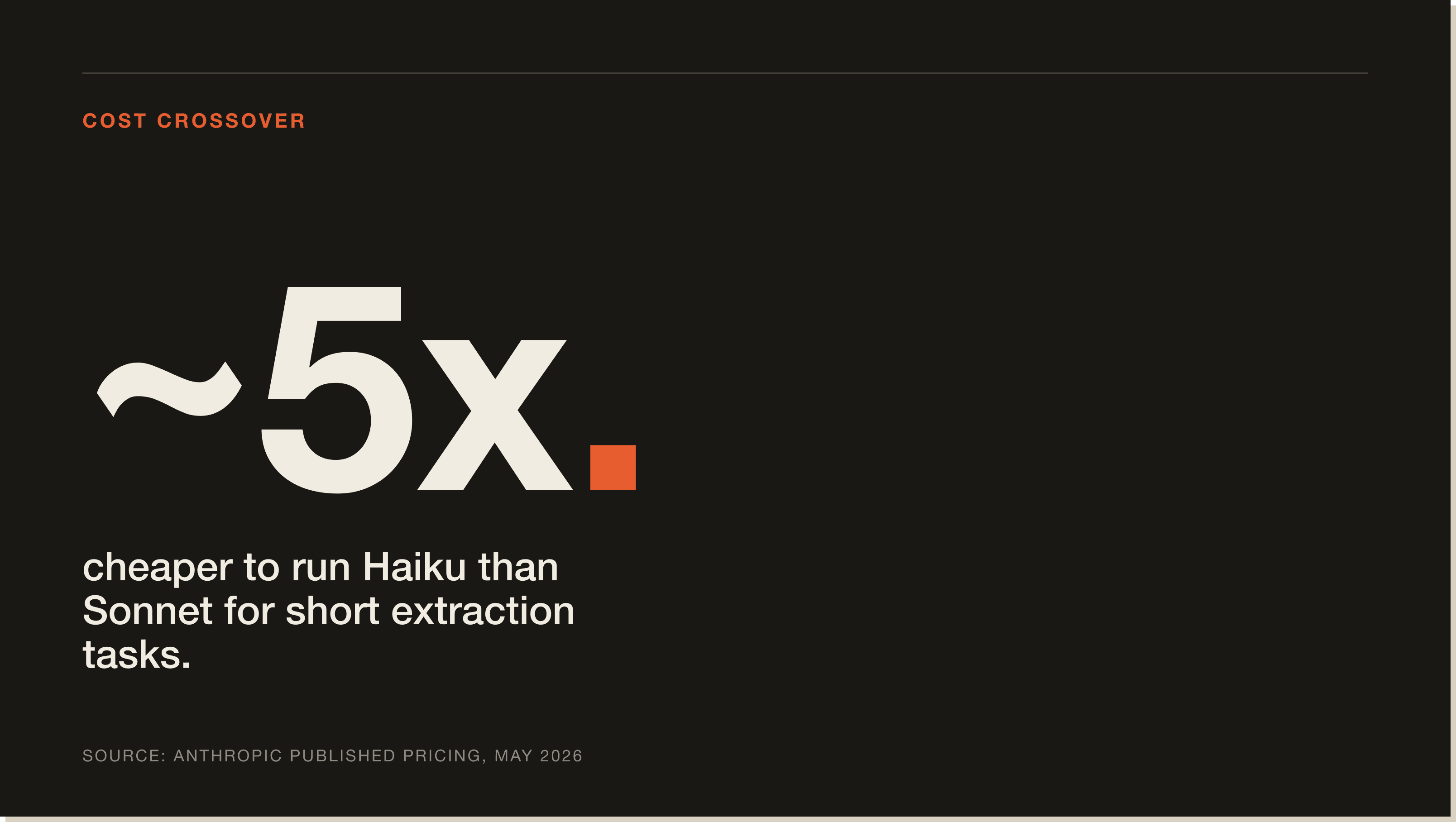
At $1 per million input tokens, Haiku 4.5 is five times cheaper than Sonnet 4.6 and five times cheaper again than Opus 4.7. For batch work that does not need deep reasoning, routing a task through Haiku first and escalating to Sonnet only when confidence is low is a real cost optimisation, not just a theoretical one. I have seen this pattern knock 70-80% off API spend on pipelines that were naively using Sonnet for everything.
The tradeoff is the 200k context window (versus 1M on Opus and Sonnet) and the older knowledge cutoff. For most batch jobs this is not a constraint. For anything that needs to hold a long conversation or reason across a massive codebase, it is.
Sonnet 4.6 is the model I use by default for everything. Code review, first drafts of complex scripts, multi-file refactors that fit inside a reasonable context window, explaining a codebase to a new team member, summarising a research paper. It is fast enough to feel like a conversation. It is capable enough to handle most tasks on the first pass.
The price is $3 per million input tokens and $15 per million output. Inside a Claude Code subscription (Pro or Max), this is what you are spending your weekly cap on by default. The 1M context window means you can drop an entire project directory in without hitting limits, and the August 2025 reliable knowledge cutoff means it knows about most of the tools released in the last year.
Sonnet 4.6 also supports extended thinking, which lets it reason step-by-step through hard problems before responding. This narrows the gap with Opus 4.7 on structured reasoning tasks without the Opus price.
Opus 4.7 is the model you reach for when the task is genuinely hard. Multi-file architecture decisions. Debugging a problem where you have already looped twice and the model keeps getting it wrong. Anything involving a 1M context window where you are asking it to reason across a very large codebase or document set. Irreversible production work where an error costs real time to undo.
The pricing of $5 per million input tokens and $25 per million output is roughly five times Sonnet per token on a subscription basis. Inside Claude Code, this is why the CLAUDE.md model defaults in my setup say: "Default to Sonnet 4.6. Opus 4.7 is the escalation tier." The question is not whether Opus is better. It is whether the task is hard enough to justify the cost.
Opus 4.7 has a step-change improvement in agentic coding according to Anthropic's own comparison against Opus 4.6. If you are running long multi-step agent loops, Opus 4.7 is the right model. It sustains performance across hours of task execution in a way smaller models do not.

The model pricing from the official Anthropic docs page, current as of mid-2026:
Haiku 4.5: $1 input / $5 output per million tokens.
Sonnet 4.6: $3 input / $15 output per million tokens.
Opus 4.7: $5 input / $25 output per million tokens.
So Opus is five times the per-token cost of Haiku and roughly 1.7 times the cost of Sonnet. When should you pay five times more for Opus?
When the task takes more time to debug on Sonnet than the cost difference covers. If a Sonnet loop takes you six back-and-forth turns to solve something Opus gets in two, Opus is cheaper on wall-clock time even if it costs more in tokens. The crossover is task complexity, not task type.
The batch API brings all three models down by roughly 50% for non-time-sensitive work. If you are building a data pipeline or a nightly enrichment run, batching on Haiku 4.5 is the cheapest path by a wide margin.
---
[CTA-BLUEPRINT]
---
Sonnet 4.6 handles most coding tasks. It covers code review, function-level rewrites, unit tests, and most debugging scenarios. For everyday coding work inside Claude Code, Sonnet is what you want on by default.
Opus 4.7 wins on complex architecture decisions, large-scale refactors that touch many files, and debugging hard problems where the root cause is not obvious. On SWE-bench, the original Claude Sonnet 4 (the first iteration, now deprecated) scored 72.7%. Opus 4 hit 72.5% on SWE-bench and 43.2% on Terminal-bench at launch. The iteration releases since have improved on those numbers.
For agentic coding specifically, where the model has to plan and execute a multi-step workflow without constant hand-holding, Opus 4.7 is Anthropic's recommended model. Sonnet 4.6 handles most of it, but on tasks that require sustained performance across a long context, Opus 4.7 is more consistent.
Claude 3.5 Sonnet (claude-sonnet-3-5) is a previous generation model, not part of the Claude 4 family. It is still available and still capable for many tasks. But Claude Sonnet 4.6 has better reasoning, a newer knowledge cutoff, and a 1M context window versus Claude 3.5 Sonnet's 200k. If you are on Claude 3.5 Sonnet in your API calls, migrating to Sonnet 4.6 is a straight upgrade in almost every dimension. The search volume for Claude 3.5 Sonnet (5,400 per month) tells you a lot of people are still on it. Most of them should move.
Claude Code lets you set the default model and override it per session or per task. The way I run it:
Default model is Sonnet 4.6. Most tasks run there. When I hit something that Sonnet has looped on twice, I switch to Opus using the /model command in Claude Code. When I need to process a large batch of files quickly and cost matters, I drop to Haiku in a script that calls the API directly.
You can also set the model via the environment. Set ANTHROPIC_MODEL=claude-opus-4-7 in your shell to override the Claude Code default for a session. This is useful when you know upfront that a task is hard enough to warrant Opus from the first turn.
The CLAUDE.md model defaults pattern I use: "Default to Sonnet 4.6. Opus 4.7 is the escalation tier at 5x token cost. Ask before escalating. Cases that warrant it: multi-file architecture decisions, hard debugging where Sonnet looped twice, irreversible production work, real planning sessions, or work needing 1M context."
For Claude Code subscription users, this matters in a different way. The model you run against your weekly usage cap burns through it at different rates. Opus burns three to five times faster than Sonnet on the same task. Use Sonnet as your daily driver and save Opus for the genuinely hard problems.
See the full guide on setting up and running Claude Code effectively: how to use Claude Code and Claude Code pricing.
No model is right for everything. A few real constraints worth knowing:
Haiku 4.5's knowledge cutoff is February 2025. If your task requires current information (recent tool releases, API changes from the last year), Haiku will get it wrong. Use Sonnet 4.6 or Opus 4.7 for anything time-sensitive.
Opus 4.7 is slower than Sonnet at the same task. The moderate latency is fine for planning and architecture work where you are reading the output carefully. It is less fine for iterative debugging where you want tight feedback loops.
The context windows sound enormous (1M tokens is approximately 750,000 words for Sonnet), but very large contexts can degrade model performance on needle-in-a-haystack retrieval tasks. Dropping an entire 1M token codebase and asking "find the bug" is less reliable than scoping the context to the relevant files first.
Claude 4 models do not have real-time internet access via the standard API. If your workflow requires live web data, you need to bring in tools or an MCP server that handles web search. The models themselves are frozen at their training cutoffs.
Every two to three months, Anthropic ships an incremental iteration. Opus 4.5 became Opus 4.6, then Opus 4.7. Sonnet 4 became Sonnet 4.5, then Sonnet 4.6. There is a predictable pattern of people dropping what they are doing to retest and re-benchmark every release.
Most of the time, the difference between adjacent iterations is smaller than the difference between using the model well and using it badly. A well-constructed prompt on Sonnet 4.6 will outperform a lazy prompt on Opus 4.7 on most tasks. The fundamentals of prompting, providing context, and scoping tasks clearly matter more than chasing the freshest release.
The exceptions are real step-changes. Opus 4.7's agentic coding improvement over 4.6 was significant enough to warrant switching. The jump from Claude 3.5 to Claude 4 generation was real across the board. But within a generation, between minor iterations, the upgrade is rarely the most important variable in your workflow.
Pick your tier (Haiku, Sonnet, or Opus), use it well for a month, and only switch when there is a specific task where the current model is genuinely failing you. That approach will save you more time than constant benchmarking.
---
[CTA-BLUEPRINT]
---
The best Claude model depends on the task. Opus 4.7 is Anthropic's most capable generally available model. Sonnet 4.6 is the best combination of speed and intelligence for daily use. Haiku 4.5 is the best for cost-sensitive, high-volume workloads. Most developers should default to Sonnet 4.6 and escalate to Opus 4.7 selectively.
Claude Opus 4 models are larger, more capable, and slower, designed for complex reasoning, agentic workflows, and tasks where quality matters more than speed. Claude Sonnet 4 models are faster, cheaper, and still highly capable, designed as the primary daily driver for coding, writing, and analysis. On API pricing, Opus 4.7 is $5/$25 per million tokens versus Sonnet 4.6 at $3/$15 per million tokens.
Claude Haiku 4.5 is the fastest and cheapest model in the Claude 4 family, priced at $1 per million input tokens and $5 per million output tokens. It has a 200k token context window and a reliable knowledge cutoff of February 2025. It is designed for production batch workloads, routing logic, and any high-volume pipeline where cost per token matters.
Yes. Claude Sonnet 4.6 has better reasoning, a larger 1M token context window (versus 200k for Claude 3.5 Sonnet), a newer knowledge cutoff, and support for adaptive thinking. For almost every use case, Sonnet 4.6 is a straight upgrade. The main reason to stay on Claude 3.5 Sonnet is existing integrations where the cost of migration outweighs the benefit.
Use the /model command in a Claude Code session to switch models on the fly. You can also set ANTHROPIC_MODEL=claude-sonnet-4-6 (or another model ID) as an environment variable to change the default for a shell session. Inside a CLAUDE.md file in your project root, you can document the model defaults your project uses so Claude Code respects them automatically.
Claude Opus 4.7 has a 1M token context window, which is approximately 555,000 words or 2.5 million Unicode characters, using a new tokenizer introduced with this model version. Max output is 128k tokens. On the Message Batches API, Opus 4.7 supports up to 300k output tokens using the extended output beta header.
Default to Sonnet 4.6. Escalate to Opus 4.7 for multi-file architecture decisions, hard debugging where Sonnet has looped twice, irreversible production changes, planning sessions requiring 1M context, or long-running agentic tasks. Opus 4.7 costs roughly five times more per token than Sonnet 4.6, so the escalation should be deliberate, not habitual.
The original Claude Sonnet 4 (claude-sonnet-4-20250514) and Claude Opus 4 (claude-opus-4-20250514) are deprecated and scheduled for retirement on June 15, 2026. The current production models, Opus 4.7 and Sonnet 4.6, have no announced retirement date. Haiku 4.5 is also current with no announced deprecation.
Picking the right Claude model is one decision. Using Claude Code well is a month-long practice. The fastest way to shortcut that is the free Claude Code Blueprint: 60 minutes, no coding required, and you come out with a working setup, your first real build, and a clear sense of which model tier fits your work. If you want to go further and actually ship something in 30 days, the 30-Day Claude Code Challenge is the cohort.
For a deeper look at how Claude Code works and how to get the most out of your model choice, see the Claude Code guide and Claude Code memory.
It depends on the task. Opus 4.7 is Anthropic's most capable generally available model. Sonnet 4.6 is the best combination of speed and intelligence for daily use. Haiku 4.5 is best for cost-sensitive, high-volume workloads. Most developers should default to Sonnet 4.6 and escalate to Opus 4.7 selectively. Three different tools for three different kinds of work, not best/better/good.
The 4 refers to the generation. Opus, Sonnet, and Haiku are size tiers. The decimal (the .7 in Opus 4.7, the .6 in Sonnet 4.6) is the iteration count within that tier. Opus 4.7 does not mean Opus is version 7 of something. It means Anthropic has shipped seven iterations of the Opus 4 tier. Version numbers are not synchronised across tiers. Sonnet 4.6 came out after Opus 4.5. Check the official models page.
Haiku 4.5: $1 per million input tokens, $5 per million output. Sonnet 4.6: $3 input, $15 output. Opus 4.7: $5 input, $25 output. So Opus is five times the per-token cost of Haiku and roughly 1.7 times the cost of Sonnet. The batch API drops all three by roughly 50% for non-time-sensitive work. Routing a task through Haiku first and escalating to Sonnet only when confidence is low can cut 70-80% off API spend on pipelines that were naively using Sonnet for everything.
Default to Sonnet 4.6. Escalate to Opus 4.7 for multi-file architecture decisions, hard debugging where Sonnet has looped twice, irreversible production changes, planning sessions requiring 1M context, or long-running agentic tasks. Opus costs roughly five times more per token than Sonnet, so the escalation should be deliberate, not habitual. On a subscription, Opus burns three to five times faster against your weekly cap.
Yes. Sonnet 4.6 has better reasoning, a 1M token context window (versus 200k on Claude 3.5 Sonnet), a newer knowledge cutoff, and support for adaptive thinking. For almost every use case it is a straight upgrade. The search volume for Claude 3.5 Sonnet (5,400 a month) tells you a lot of people are still on it. Most of them should move.
Use the /model command in a Claude Code session to switch on the fly. Set ANTHROPIC_MODEL=claude-sonnet-4-6 as an environment variable to change the default for a shell session. Document the model defaults in your CLAUDE.md so Claude Code respects them automatically. The pattern I use: 'Default to Sonnet 4.6. Opus 4.7 is the escalation tier at 5x token cost. Ask before escalating.'
The original Claude Sonnet 4 (claude-sonnet-4-20250514) and Claude Opus 4 (claude-opus-4-20250514) are deprecated and scheduled for retirement on June 15, 2026. The current production models, Opus 4.7 and Sonnet 4.6, have no announced retirement date. Haiku 4.5 is also current with no announced deprecation. Starting with the 4.6 generation, Anthropic moved to dateless model IDs that point to fixed releases.
Five interactive lessons. Install Claude Code, build your first automation, and deploy it live on the internet — all in under an hour. Free, no coding required.
Grab the Blueprint →