How to start AI automation for a small business with the one job that costs your team at least 4 hours a week.
AI automation for small business means a custom system built around the tools you already run. How to pick the first job, get it built, and what it costs.
A custom automation gets built around the software you already run, so your team keeps its tools and loses the repeated work.
AI automation for small business means a custom system that does the repeated admin your team still does by hand. It reads the tools you already pay for, like your inbox, your accounts export and the spreadsheet that acts as your CRM. Then it does the work and hands a person something to check.
Today that system gets built with Claude Code or Codex. A Claude subscription costs about $20 a month, and that only gets you in the door. Someone still has to turn one job in your business into a working system, and this guide covers how that happens.
In this guide:
✓What AI automation is, and why another software subscription won't do it
✓How to pick the first job
✓The six steps from that job to a working system
✓Three ways to get it built, with the time and cost of each
What is AI automation for a small business?.
AI automation is a system built for one job in your business, around the tools you already use. You don't move off QuickBooks or your inbox. The automation reads what those tools already produce and does the repeated work on top of them.
That makes it different from buying software. A chatbot, a CRM add-on or a Zapier connection each do what the vendor decided they should do. If all you need is two apps passing data to each other, a connector is fine and you should stick with it.
AI automation is for the jobs with reading and judgment in them. One system I built reads a 500-result exam-board PDF, scanned pages included, and matches every page to the right candidate.
I build with Claude Code. It isn't a chatbot and it isn't a drag-and-drop builder. You describe the work in plain English, connect it to your systems, and it writes the software.
Should you buy software or have an automation built?.
Buy software when it already does the whole job. Have an automation built when the job is specific to how your business runs.
Buying software
A custom automation
Cost to start
A monthly fee for each tool
About $20 a month if you build it yourself, from $10,000 if I build it
What your team has to do
Learn a new tool and move their work into it
Keep the tools they have and use one finished screen
How well it fits
It does what the vendor built
It handles your documents, your records and your rules
Who owns it
You rent it
It runs on your own accounts and you hold every login
Software is cheap to buy, and that's the trap. Every tool you add has a learning curve, and your team pays for it in hours.
Chris Cole runs a small engineering firm in the San Francisco Bay Area and builds his own systems with my coaching. "I finally canceled my Adobe Creative Cloud subscription because I don't use it anymore," he says.
He was paying about $6,000 a year for Tableau and doesn't plan to renew it. His own project control system takes over in January 2027, and he puts that saving at about $25,000.
Chris Cole builds his own systems with Claude Code and Codex.
What can a small business automate with AI?.
The jobs that pay back are the boring internal ones. They come back every week, they follow the same steps, and nobody on your team wants to do them.
Job
What the automation does
Inbox and support triage
Reads each email or ticket, tags it, and routes it to the right person with a draft reply
Lead follow-up
Reads a new enquiry, looks up the company, updates the CRM and drafts the first reply
Document processing and data entry
Pulls names, amounts and dates out of PDFs and forms and files them in the right record
Invoices and receipts
Reads the invoice, sets the category in your accounts and flags anything odd
Meeting notes
Turns a call transcript into decisions, tasks and CRM notes
Weekly reports
Pulls the numbers from your systems and writes a short summary of what changed
Proposals
Builds a first draft from the client's intake form and your pricing
First drafts of content
Turns a call recording or a long article into draft posts for a person to edit
My test for a good candidate has three parts. The job is repetitive, it involves reading or research, and the output has a set shape. If it's heavy on judgment or it only happens once, leave it alone.
Which job should you automate first?.
Start with the job your team repeats by hand that costs the most hours. If it costs at least 4 hours a week, it's worth automating.
Sanjeev runs Exam Centre Birmingham, with 600 to 800 candidates at peak across four exam boards. Splitting one 500-result exam-board file into candidate folders took his team about 5 hours by hand. Four boards each send a file every series, so that's roughly 20 hours of filing per series by my estimate.
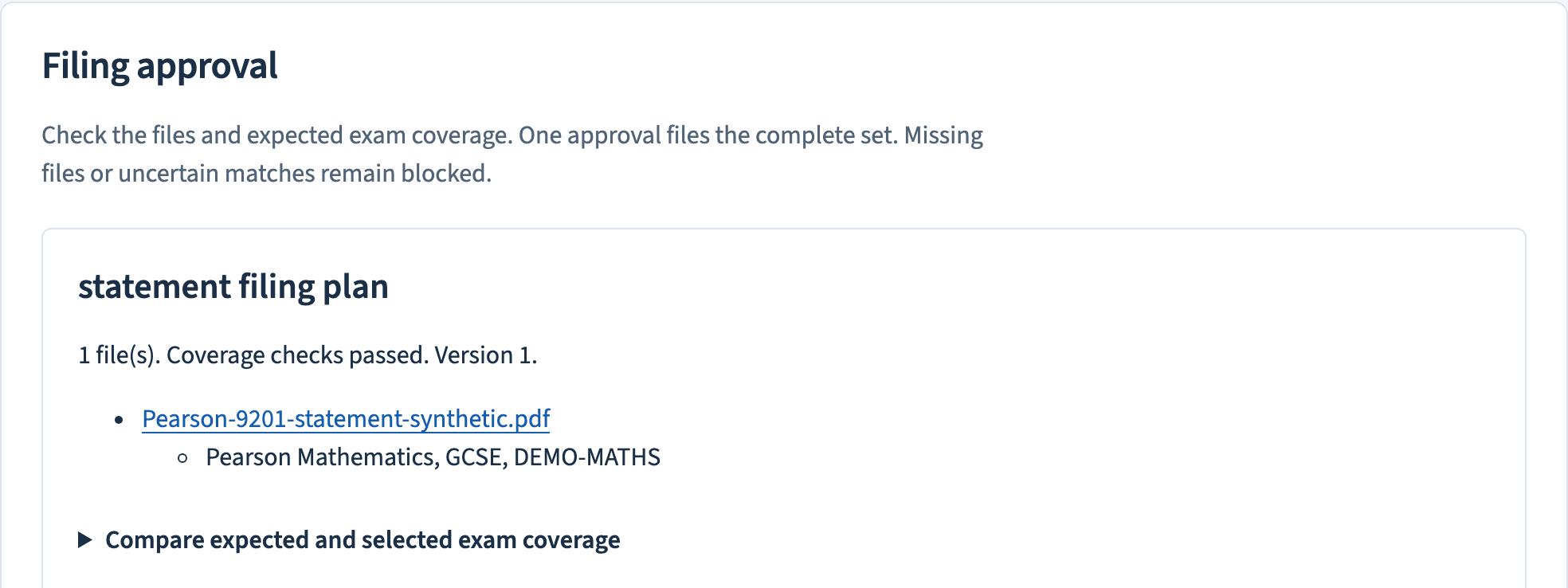
That job was the right first pick because it came back every series and the hours were easy to count. Now staff upload the exam-board PDF once and the system matches every page to the right candidate. Nothing gets filed until a staff member approves the complete set.
The exam centre system holds every filing until a staff member approves the full set.
How to get an AI automation built.
Getting one built takes six steps, and the first two decide how well the rest go.
1. Pick one job and show how it's done today.
Walk through the job from start to finish. Show where the documents arrive, who touches them and where they end up.
2. Write the brief.
The brief says what the system reads, what it produces and who signs it off. It also sets the quote, because the price depends on how complex the job is.
3. Build a first version.
When I build it, a working first version usually takes 7 to 14 days. The biggest variable is how quickly I get access to your accounts and the documents the system will handle.
4. Agree where a person checks the work.
Decide which steps wait for a human. In the exam centre system, missing files and uncertain matches stay blocked until a staff member checks them. That check is what keeps a wrong result out of a candidate's folder.
5. Deploy it on your own accounts.
The system runs on your own hosting account, and you hold every login. Your team uses the finished screens and doesn't need any technical skills. Plan an hour to walk them through the screens before the old way of doing the job stops.
6. Keep it running.
Software around it changes, so someone has to look after it. I charge $500 to $1,000 a month for maintenance, and new features are quoted separately.
Three ways to get your first AI automation built.
You can build it yourself, have your team build it with coaching, or have it built for you.
Route
What it costs
How long it takes
Who it suits
Build it yourself with Claude Code
About $20 a month for Claude Pro
About an hour for a first usable build, and 30 days to feel confident
Keven Elison is a VP of marketing with more than 35 years in marketing, and he always thought he was never going to be a coder. He paid someone to build his first workflow, then built a content system of more than 180 steps himself with my coaching. He has since launched a product he built on his own in Claude Code.
Keven Elison built his own content system and then a product in Claude Code.
Agencies charge from about $10,000 to $100,000 for a custom build, depending on how many systems it touches. The full ranges are on a separate page: how much AI automation costs.
Will AI automation replace your staff?.
No. The automation takes the repeated part of the job, and a person still checks the output and makes the judgment calls.
Kyle Rucker is Operations Lead at SMSI Group, a manufacturer with 150+ staff, and his team built their systems with my coaching. One admin got 4 to 5 hours a day back. "We've taken three brilliant people off manual, low-level work and freed them up for high-level work," he says.
Kyle Rucker, Operations Lead at SMSI Group.
Questions small business owners ask about AI automation.
What can AI do for a small business?
AI can take over repeated admin that involves reading and sorting. That covers triaging the inbox, following up leads, pulling data out of documents, filing invoices and writing weekly reports. A person still approves the result.
Which AI tools are best for beginners?
Claude Code is the one to start with. You don't need coding experience, because you describe the work in plain English and it does the writing while you do the directing. Codex is the alternative, and it comes with a ChatGPT Plus plan at $20 a month.
Is AI automation affordable for a small business?
Yes, if you match the route to the job. A build you do yourself costs about $20 a month, and a job of 4 hours a week covers that many times over. A build done for you starts from $10,000 and pays back fastest on jobs that cost your team 10 hours a week or more.
Do you need technical skills to use AI automation?
No. If you have a system built for you, your team only uses the finished screens. If you build it yourself with Claude Code, your part is to point and confirm.
How long does AI automation take to set up?
It takes about an hour to get a first usable build out of Claude Code yourself, and about 30 days to feel confident with it. When I build it for you, a working first version usually takes 7 to 14 days.
Should you build it yourself or have it built?
Build it yourself if you want the skill and you have the hours. If you want the job gone as fast as possible, have it built. If you want your team able to build the next one, coaching is the better fit.
If you'd rather have the job built and running on your own accounts, that's my AI consulting service.
Free · 60 Minutes · No coding required
The Claude Code Blueprint.
Five interactive lessons. Install Claude Code, build your first automation, and deploy it live on the internet — all in under an hour. Free, no coding required.