← Back to Blog
Claude Code for SEO: How I Ranked #1 on Google.
How I use Claude Code and the DataForSEO MCP to build a keyword-researched content cluster that ranks on Google, the exact 6-prompt SEO workflow.
How I use Claude Code and the DataForSEO MCP to build a keyword-researched content cluster that ranks on Google, the exact 6-prompt SEO workflow.
Yes, Claude Code can do SEO, and it does it better than most agencies charging thousands a month. I've been using Claude Code with the DataForSEO MCP to build a keyword-researched content cluster that's ranking on Google and getting cited by ChatGPT and Perplexity.
This is the exact workflow. Six prompts. No guessing, no expensive SEO tools, no outsourcing.
Claude Code can't pull keyword data on its own, ask it for live search volumes and you'll get hallucinated numbers at best, outdated guesses at worst. But connect it to a real SEO data provider via MCP, and the whole picture changes.
What an MCP (Model Context Protocol) does is give Claude Code tools that map directly to API calls. So instead of Claude guessing, it's querying live keyword data, search volumes, and SERP results and building your strategy from actual numbers. That's the unlock.
The MCP I use for this is from DataForSEO. They provide data for search engine results pages, keyword overviews, keyword ideas, backlink analysis, on-page SEO, domain analytics, and more. It's a well-known data provider in the SEO industry, and their MCP plugs directly into Claude Code.
To install it, go to their integrations page and find the DataForSEO MCP. Method two is the recommended path: install it locally via NPM. You'll need your API username and password from their API access page (the username is a short alphanumeric string they email you, not your login email). Paste your credentials into the install command, make sure there are no extra spaces around the equal signs, and run it in your terminal.
Once installed, tell Claude Code to add the MCP globally, then restart Claude Code. When it loads back up, you'll have access to the full DataForSEO toolkit: keyword overviews, keyword ideas, keyword suggestions, SERP organic results, on-page optimization, domain analytics, and content analysis. The whole suite is there.
One dollar in DataForSEO API credits is hundreds of calls. I ran all my keyword research for the blog without topping up past the initial trial credit.
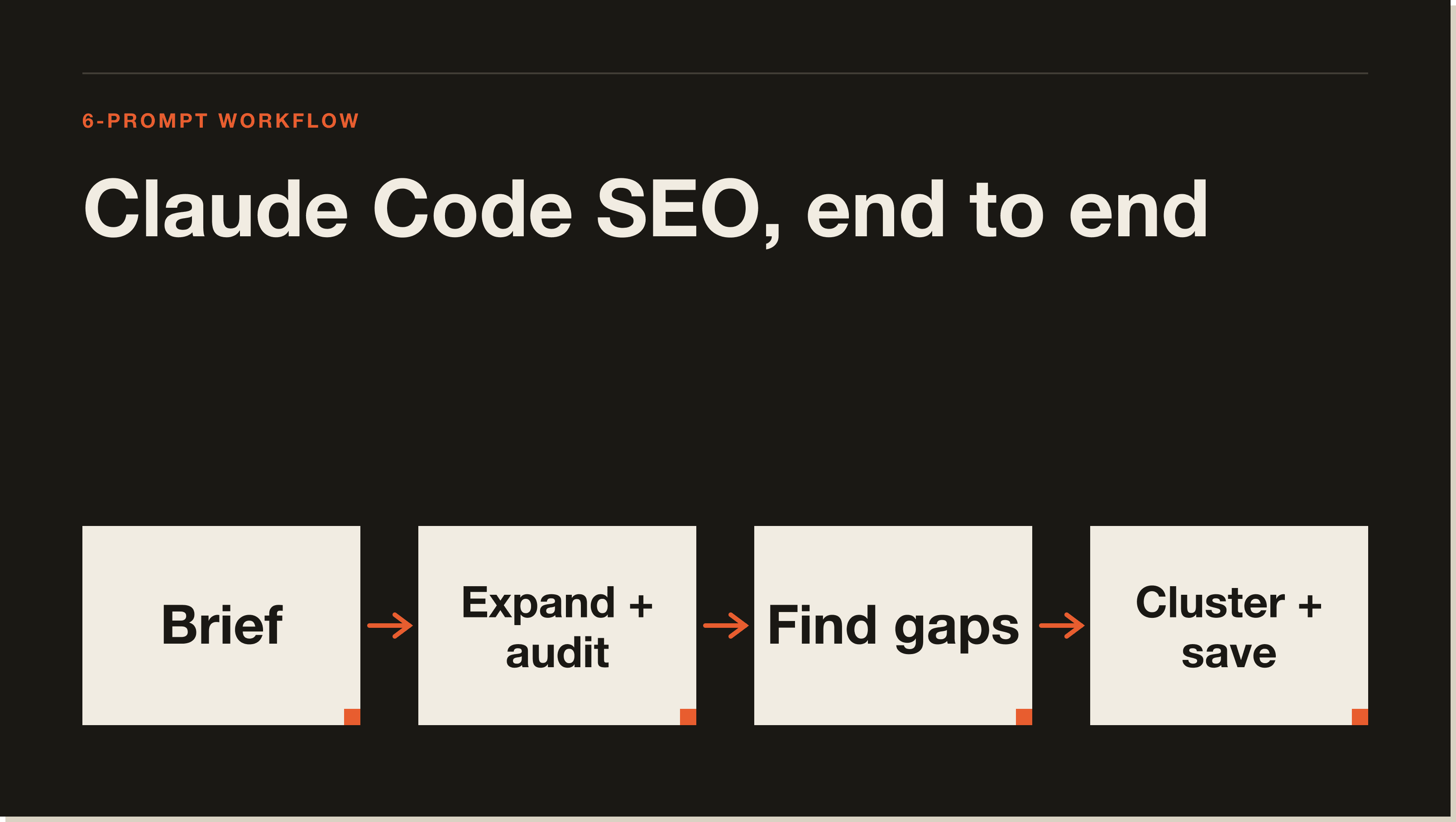
This is the workflow as I ran it. Six prompts in Claude Code, starting from a blank slate and finishing with a validated, competitive, clustered content roadmap.
Prompt one is about getting clear on what you actually want to rank for. If you already know your niche and target keywords, you can skip this step. If you're starting from scratch, you voice-note or type your answers into Claude Code and it asks follow-up questions to build a brief.
What it produces: a keyword research brief with your business described in one sentence, your target buyer described in one sentence, the top three buyer pains, and a set of seed keywords that map to how your buyers are actually searching. Some are problem-aware keywords. Some are solution-aware.
Prompt two takes your seed keywords and expands them into a candidate list. The filter is set to surface keywords with search volume above 100 per month for general keyword ideas, and above 200 for related keywords. You also get question-based variants of each seed.
Claude Code fires these calls in parallel, spinning up sub-agents to hit the DataForSEO MCP simultaneously. When it came back on my run, it produced 58 keywords (not the 80 to 100 the prompt targets, so I ran a second pass). The second pass asks it to refocus on your specific audience and drop keywords that belong to competitors you can't beat.
For my business, the keywords that had the most volume were clustered around Claude Code. That's my audience: people who want to get better at using Claude Code to build things.
Prompt three pulls LLM-era search data for each of your seeds. It also tries to identify the top 15 domains that LLMs cite most often when answering questions about your topic, and the 15 most-cited individual pages.
On my run, the LLM-specific volume data was limited. But what it did surface was important: Reddit appeared for every single keyword in my niche. That makes Reddit a massive citation source and a legitimate part of any SEO strategy in this space.
The prompt also surfaces four content format preferences for LLMs: Reddit threads, official documentation, Medium one-shot posts, and niche industry blogs. So if you want your content showing up in ChatGPT or Perplexity answers, those are the formats worth mimicking.
Prompt four is the competitive analysis. It asks Claude Code to identify what your direct competitors are ranking for that you are not.
On my run it came back with 275 gap keywords. The keyword difficulty scores on several of these were in single digits, I saw 1, 3, 7, 8, 12. Those are the ones worth targeting first. Low competition, real volume, already being ranked for by sites you can beat.
One specific example I flagged: "Is Claude down right now?" gets searched constantly whenever the service has issues. Keyword difficulty was minimal. That kind of informational keyword is easy to rank for and drives consistent traffic.
This is the kind of analysis that costs serious money in a traditional SEO tool. Here it ran in a few minutes via Claude Code sub-agents working in parallel.
Prompt five synthesises everything into an executive summary with a cluster overview table. A cluster is a group of 15 to 20 articles built around interrelated keywords that all support each other, linking internally to boost the authority of the whole group.
This is the model I'm building on my blog right now. I started it last week. Every YouTube video I make turns into a full-length blog post on the same topic, then those posts interlink inside a keyword cluster.
The cluster I planned out has 15 articles, each targeting specific long-tail keywords from the research. The posts are being written using a content writing skill I built specifically for SEO articles. The CMS is Sanity, hooked up to Claude Code, deployed via Vercel. Each post lands in a draft queue and publishes on a scheduled drip.
The final prompt generates and saves the complete strategy file. It includes the discovery summary, executive summary, the cluster overview table, the gap keywords, the competitive domain analysis, and content priorities.
This document is your working brief for writing every article in the cluster. When I ran this the output was saved as "SEO strategy V2" and updated the plan I'd built the week before.
The six-prompt workflow takes you from no keywords to a competitive, clustered, data-validated content roadmap. Keyword research is the most important phase of the entire process. Get it wrong and you're writing articles that either can't rank or are too competitive to rank. Get it right and every article you write is targeted at a winnable keyword with real search volume.
No. Claude Code's training data has a knowledge cutoff and it does not have live access to search data. To get accurate, current keyword volumes and difficulty scores you need to connect Claude Code to a live SEO data provider via an MCP like the DataForSEO MCP.
DataForSEO is an SEO data provider that offers an API for keyword data, SERP results, backlink analysis, and on-page SEO. Their MCP connects that API to Claude Code, giving Claude Code tools it can call directly instead of guessing. You install it locally via NPM using your DataForSEO API credentials.
One dollar in DataForSEO API credits covers hundreds of API calls. I completed my full keyword research workflow for the blog without spending beyond the initial trial credit. For a workflow like this the API cost is negligible, which is the point: the data that used to require an expensive SEO subscription now costs cents.
A content cluster is a group of blog posts built around interrelated keywords that all link to each other. Instead of writing isolated articles, you build 15 to 20 posts that reinforce each other's authority and signal to Google that your site is a comprehensive resource on a topic. It's the structure behind ranking for multiple keywords at once rather than just one.
Claude Code handles the research and strategy phases well when connected to DataForSEO. It fires parallel sub-agents to run multiple API calls simultaneously, which speeds up keyword expansion and competitive gap analysis significantly. The writing phase is separate and benefits from a dedicated SEO writing skill configured for your voice and blog format.
Yes. The same signals that help you rank in Google are what LLMs like ChatGPT and Perplexity pull from when answering questions in your niche. Reddit, official documentation, Medium, and niche industry blogs are the four content formats LLMs prefer to cite. If your content follows the same structure and authority signals, it shows up in AI search answers, not just Google.
I run a Next.js site with Sanity as the CMS, deployed on Vercel. Sanity is connected to Claude Code so posts can be generated and piped directly into the content management layer. That setup is not required, the keyword research and strategy workflow works regardless of your tech stack.
If you want to start using Claude Code for tasks like this, the Claude Code Blueprint walks you through the fundamentals from scratch. You install Claude Code, open the folder, and Claude teaches you live inside the tool while you use it. By the end you'll have shipped a real application, learned how to configure your CLAUDE.md file, and run parallel agents inside Claude Code.
Get the Blueprint at /blueprint and get started today.
If you're looking to go deeper on Claude Code's capabilities, these posts cover the adjacent ground: how to get started with Claude Code end-to-end, the skills and slash commands system, custom Claude Code commands, and the best MCP servers worth adding to your setup. If you want to see what else Claude Code can be used for beyond SEO, the Claude Code use cases rundown covers a range of real applications.
Five interactive lessons. Install Claude Code, build your first automation, and deploy it live on the internet — all in under an hour. Free, no coding required.
Grab the Blueprint →