← Back to Blog
Claude Code Use Cases: What I Actually Build With It.
Claude Code use cases go far past writing code. Here are the real ones I ship with it: content pipelines, lead-gen sites, agents and back-office automation.
Claude Code use cases go far past writing code. Here are the real ones I ship with it: content pipelines, lead-gen sites, agents and back-office automation.
Claude Code use cases run far past writing code. It is a command-line agent that reads and edits files, runs commands, and chains multi-step jobs, which means it can build software, automate content, run business operations, and stand up internal tools. Most people meet it as a coding assistant. I use it as the engine my whole business runs on.
I'm Tom. I run a mentorship and content business almost entirely through Claude Code, from the blog you are reading to the lead-gen sites, the marketing agents, and the back-office plumbing nobody sees. This post is the honest list of what I actually build with it, not a generic feature tour. Every example below is something running in production right now.
[CTA-BLUEPRINT]
The main Claude Code use cases fall into five buckets: shipping production code, automating content, building internal tools and dashboards, running operational workflows like data sync and reporting, and standing up autonomous agents that run on a loop. The first is the obvious one. The other four are where the real leverage sits, because they let one person operate like a team.
The reason it stretches that far is simple. Claude Code is not a chat window that hands you a snippet. It is an agent with hands. It can open your files, write new ones, run a script, read the output, and decide what to do next. Any task that lives in files and commands is a candidate. That covers a lot more than a codebase.
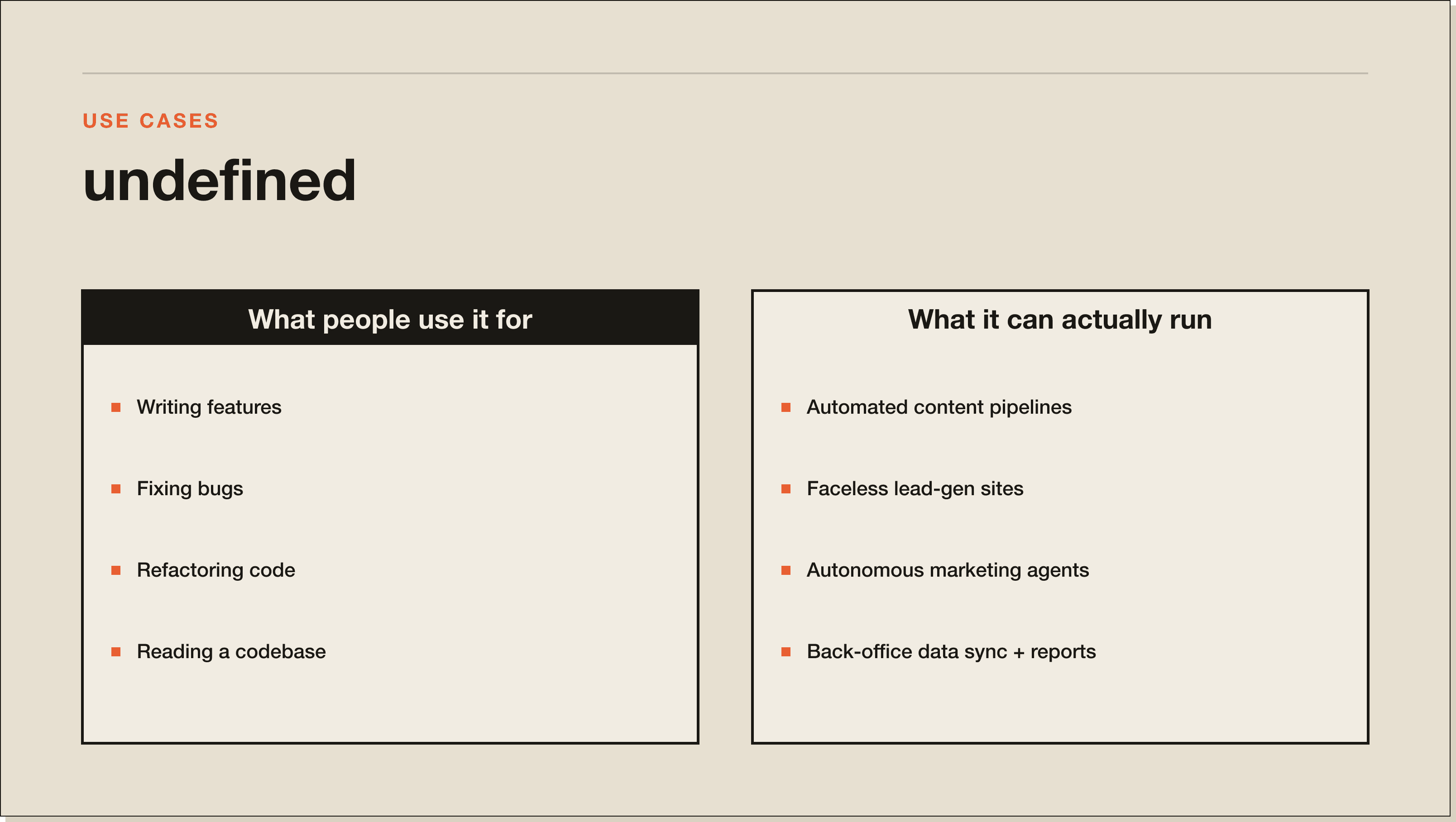
Developers use Claude Code to build features, fix bugs, refactor across many files, and understand unfamiliar codebases without reading every line. You point it at a repository, describe the change, and it plans the edits, makes them, and runs the tests. The official common workflows guide covers the core coding patterns: fixing a bug from a stack trace, adding a feature, and onboarding to a new code base.
This is the use case Anthropic built it for, and it is genuinely strong. But if you stop here, you are using maybe a fifth of what it can do. The same agent that edits a React component can just as easily run your Tuesday reporting job. Here are the use cases that changed how I work.
I produce the AI Architects blog through a Claude Code pipeline, end to end. I drop in a video URL or a topic, and a custom skill pulls keyword data, writes a 2,000-word post in my brand format, generates a branded cover image, builds an in-body diagram, and imports the whole thing to my CMS as a draft. A second job publishes one post a day on a drip.
The point is not that Claude wrote some words. The point is that the research, the formatting, the image generation, and the publishing are all one orchestrated run. That is a use case a chat assistant cannot touch, because it needs an agent that can run scripts and touch a CMS, not just generate text.
I built a faceless local lead-gen site with Claude Code, from the Next.js front end to the content cluster to the deploy. It generates comparison guides backed by real local pricing data, follows a strict on-page SEO contract, and ships to production with one command. No founder face, no personal brand, just a clean publisher that answers buyer questions.
This works because Claude Code holds the whole project at once. It writes the page component, follows the SEO checklist, generates the guide content, and runs the deploy, all inside one repository it understands. For a solo operator, spinning up a fresh revenue site is a weekend, not a quarter.
I run marketing agents that loop on a schedule. One drafts replies to relevant Reddit threads into a queue, re-scores them for traction, and sends me an approval digest three times a day. Another does the same for PR opportunities. I approve or reject from my phone, and only approved items go out, one at a time, never in a burst.
These are not one-shot prompts. They are long-running jobs with state, gating, and human approval baked in. Claude Code is the right tool because the loop reads a queue file, scores entries, writes back, and pings me, which is exactly the file-plus-command pattern it excels at. A real client, Doug Loud, used the same idea to build a one-click dashboard that hides Claude, n8n, and Qdrant behind a simple web button for his non-technical team. The full breakdown is in his case study.
I have used Claude Code to wire up the boring, high-value plumbing: syncing transactions between a bank, a payment processor, and a database, generating monthly reports, and pulling new applications into pre-call briefs on a timer. These are the jobs that quietly eat a founder's week, and they are perfect for an agent because they are repetitive, rule-based, and live entirely in data and scripts.
This is where the leverage compounds. One of my mentorship clients, Chris Cole, cut a two-day document workflow down to under two minutes with this style of automation. Read how in his case study. The pattern is always the same: find the manual data shuffle, describe it once, and let the agent run it forever.
Claude Code is excellent at the throwaway internal tool you would never pay a developer to build. A script that audits your content for quality issues. A dashboard that shows project status. A one-off data cleanup. Because the cost of building one is now minutes, you build the tools you used to live without.
I have a fleet of small scripts and skills that exist purely because asking for them was cheaper than doing the task by hand twice. That is a mindset shift more than a feature. When tooling is nearly free, you tool everything.
[CTA-BLUEPRINT]
You extend Claude Code with three building blocks: slash commands, skills, and agents. Slash commands package a repeatable prompt. Skills give Claude a reusable capability it loads on demand. Agents and subagents let you run work in parallel or on a schedule. Together they turn a general assistant into a system shaped around your exact workflow.
I lean on all three daily. My Claude Code commands reference covers the command layer, my guide to the best Claude Code skills covers the skill layer, and my walkthrough of Claude Code agents covers running work autonomously. If you are brand new, start with how to use Claude Code and build from there.
Claude Code is not the right tool for everything. Real-time, low-latency systems, anything needing a polished consumer UI built by hand, and workflows that demand a human's judgment at every single step are poor fits. It is an agent, so it shines where a task can be described and then run, and it struggles where the value is in continuous human taste or sub-second response.
It also is not magic on a messy foundation. If your data is chaos or your process is undefined, automating it just makes the chaos run faster. The use cases that pay off are the ones where the process is already clear enough to describe in plain English. Get the process right first, then hand it to the agent.
If you are a solo operator, a small team, or a founder doing the work of five people, Claude Code is the highest-leverage tool you can learn this year, and the coding use case is the least interesting part. The operators who win with it are the ones who stop seeing a code assistant and start seeing an agent that can run any process they can describe.
If you only ever want help writing functions, it is still excellent, but you are leaving most of the value on the table. The whole game is realising that content, ops, lead-gen, and internal tooling are all just files and commands, and Claude Code does files and commands.
[CTA-BLUEPRINT]
You can use Claude Code for content production, marketing automation, building lead-gen websites, syncing and reporting on business data, and running autonomous agents on a schedule. Any task that lives in files and commands is a candidate, because Claude Code is an agent that can read files, edit them, and run scripts, not just a chat assistant.
No. Developers get the most obvious value, but non-developers run real businesses on it. The work is in describing a process clearly, not in writing code by hand, so an operator who understands their own workflow can build automations without a traditional engineering background.
The best first use case for most small businesses is automating a repetitive data or content task that already eats hours each week. Reporting, data sync between tools, and content production are common wins because they are rule-based and live in scripts. Start with one painful weekly job and automate that before reaching for anything ambitious.
Yes. Claude Code can draft, queue, score, and schedule marketing content, and it can run those jobs on a loop with human approval gates. I run Reddit and PR outreach agents that draft replies, re-score them for traction, and send me an approval digest before anything goes live.
Yes. Claude Code can scaffold a site, write the pages, generate the content, follow an SEO contract, and deploy it to production from one repository. I have built faceless lead-gen sites this way, front end to deploy, without leaving the CLI.
You do not need to write code by hand, but you do need to be able to describe what you want clearly and check the result. Knowing the basics of how files, commands, and your own tools fit together helps a lot. The skill that matters most is process thinking, not syntax.
The fastest way to go from reading about this to running your own automation is to build one with guidance. The free Blueprint walks you through your first Claude Code build in 60 minutes, and the Challenge is where operators turn these use cases into a real system. Pick the one that fits where you are.
Five interactive lessons. Install Claude Code, build your first automation, and deploy it live on the internet — all in under an hour. Free, no coding required.
Grab the Blueprint →