← Back to Blog
5 Things I Learned Becoming Claude Certified.
I passed Anthropic's Claude Certified Architect Foundations exam in September 2026. The cost, how I studied, and 5 Claude Code lessons most builders miss.
I passed Anthropic's Claude Certified Architect Foundations exam in September 2026. The cost, how I studied, and 5 Claude Code lessons most builders miss.
The Claude Certified Architect, Foundations is Anthropic's certification exam for people who build with Claude: 60 scenario questions on agents, tools, Claude Code, prompting and context management. I passed it on 23 September 2026, after about 30 hours of study.
Foundations is the first level. There is also a Professional-level architect exam (CCAR-P), and this post covers Foundations only. Below is what the exam costs, how hard it is, how I studied for it, and the five Claude Code lessons from it that most builders never pick up.
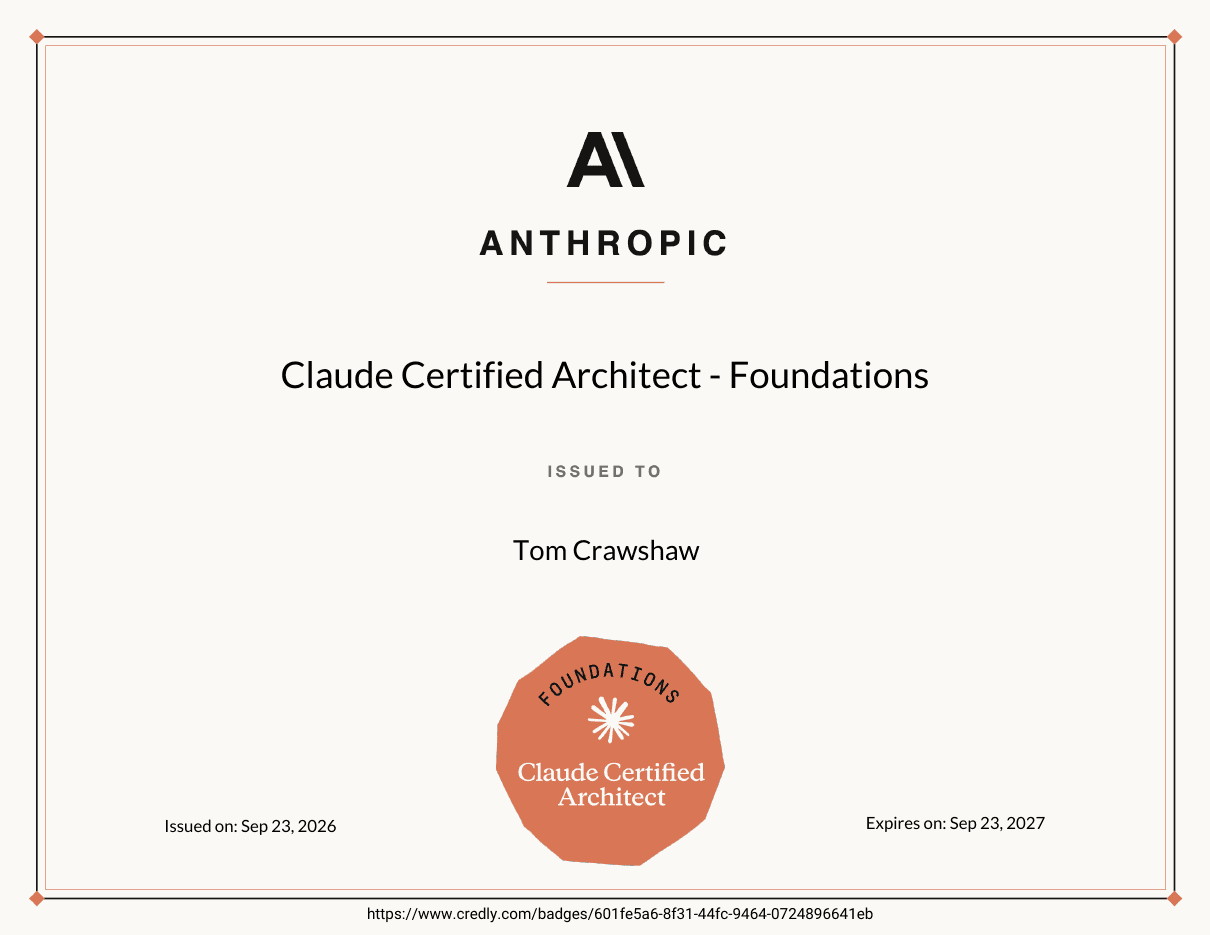
The credential is public, so you can verify it on Credly.
The Claude Certified Architect, Foundations exam (CCA-F) is a 120-minute, 60-question multiple-choice exam from Anthropic. It tests whether you can design reliable systems with the Claude API, the Agent SDK, Claude Code and MCP. Every question sits inside a real-world scenario, and your exam draws four scenarios at random from a bank of six.
Each question has one correct answer and three wrong ones. The questions are spread across five domains, weighted like this:
The first domain alone carries more marks than the MCP and context domains combined. Two of the six scenarios are built around Claude Code directly: code generation with Claude Code, and Claude Code in a CI/CD pipeline.

The Claude Certified Architect exam costs $125 USD. You can sit it online with a proctor or at a test centre, and the credential is valid for 12 months from the day it's awarded. Mine was issued on 23 September 2026 and expires on 23 September 2027.
You register through the Anthropic Academy page for the exam, which also has free courses covering the exam domains. The pass mark is 720 on a scale of 100 to 1,000, and the result only tells you pass or fail. There is no breakdown by domain afterwards.
If you'd rather have help building a Claude Code project than study for an exam, book a free 30-minute AI Audit. In 30 minutes, I'll look at your week with you and pick the first thing worth building with Claude Code.
The Claude Certified Architect exam is hard, even if you use Claude Code every day. A lot of the questions gave me two answers that would both work in a real project, and I often found it hard to tell them apart.
That's deliberate. The wrong answers are written to sound reasonable to someone who half-knows the material, so only the answer the material prefers scores, even when another option would also work.
My notes had one rule for this, and it answers a surprising number of questions. When two options both look right, pick the one that enforces the rule in code. A hook, or a tool the agent simply doesn't have, beats another instruction in the prompt.
I studied for about 30 hours over roughly four weeks, in four steps.
Anthropic's exam guide lists every domain, every task statement and the six scenarios. I read it first and planned my hours around the domain weights, with the most time on agentic architecture.
claudecertificationguide.com is a free study site with 30 lessons, more than 250 practice questions and no sign-up. Each lesson ends with a Concept Check. You paste it into Claude Code, and Claude asks you five questions, scores your answers and tells you which concepts to revise.
The mock exams show you which domains you're weak in. The real exam only tells you pass or fail, so the mocks are the only domain-level feedback you ever get.
Drill Mode on the same site serves exam-style questions on demand, so you can keep practising the domains the mocks flag. It prepared me well for the style of the real questions.
The exam spends very little time on writing better prompts. Most of it tests what happens once a job is bigger than one prompt: long sessions, sub-agents, reviews and fixes. These are the five lessons that apply to anyone using Claude Code daily, whether or not they ever book the exam.
Claude Code loads CLAUDE.md as guidance for the model to weigh. It loads every CLAUDE.md that applies to your project together, and a more specific file is not a guaranteed override. When two rules conflict, Claude can pick either one.
So a rule like "never edit the migrations folder" is only as strong as Claude's reading of it on that turn. Most builders put every rule they care about in CLAUDE.md, including the ones that must never be broken.
The fix has two steps. First, remove the rules that conflict, and check for new ones regularly. Then move anything that must never happen out of CLAUDE.md and install it as a hook or a permission rule. Claude Code enforces those whatever the model decides. My guides on Claude Code memory and Claude Code hooks cover both halves in more detail.
This prompt does the audit for you. It only proposes changes, so nothing moves until you approve it.
Read every CLAUDE.md file that applies to this project, including ~/.claude/CLAUDE.md and any in subfolders.

1. List any rules that conflict with each other, and quote both.
2. List every rule that says never, always or must.
3. For each rule in step 2, propose a hook or a permission rule in settings.json that would enforce it, and explain what it blocks.

Don't change any files. Show me the list and wait for my approval.Claude Code gets worse in long sessions because context degrades long before the window fills. The official exam guide describes the symptom: Claude starts giving inconsistent answers and talks about "typical patterns" instead of the specific files it found earlier.
Summaries make it worse, because they flatten exact numbers, dates and decisions into vague lines. Resuming yesterday's session has its own problem too. A resumed session can still hold old file reads, so if the code has changed since, Claude is working from outdated copies of those files.
Keep a short notes file in the repo instead, with confirmed paths, decisions and open questions, and have Claude re-read it rather than relying on the chat. When the code has changed a lot, start a fresh session from that file. A structured summary beats a resumed session full of stale results.
Run this before you close a long session, then point the next session at the file.
Update NOTES.md in the project root so a fresh session can pick up this work without this conversation.

Include:
- Confirmed file paths and what each one does
- Decisions made, and the reason for each
- What was tried and failed, and why
- Open questions and the next step

Keep exact numbers, names and error messages as written. Don't summarise them.Claude Code sub-agents do not see your conversation. A sub-agent receives only the prompt you write for it. To a sub-agent, "look into the bug we discussed" points at nothing, so it has to rediscover what you already know.
Write the brief as if you're handing the job to a stranger. Give it the scope, the relevant files, what you've already confirmed, the constraints, what "done" looks like and what evidence to bring back. My Claude Code agents guide covers the setup.
Forks are the one exception, because a fork starts from a copy of your conversation. Every other sub-agent starts with only the prompt.
Claude should not review its own code in the same session that wrote it. That session still holds the reasoning behind every decision, so it's less likely to question them.
According to the exam guide, an independent reviewer with none of that history catches subtle issues better than any instruction to review your own work carefully. So open a fresh session, or send a separate reviewer sub-agent with a clean brief.
For a large change, have the reviewer check each file on its own first. Then run one more pass across all the files together, to check how they fit.
Give Claude one fix at a time when the problems are independent, and all of them in one detailed message when the fixes affect each other. A long list of unrelated fixes makes it harder to tell which change fixed what, and interacting fixes need to be reasoned about together.
The other habit to drop is "that didn't work, try again". It gives Claude nothing new to work with, so it can repeat the same mistake.
Every time something fails, give Claude the real evidence: the failing test, the exact error, what you expected and what actually happened.
The exam guide is frozen at a point in time, and in a few places Claude Code has already moved on. The tool for launching sub-agents is now called Agent rather than Task, and the study site notes that allowed-tools in a skill now pre-approves tools rather than restricting them.
On the day, you answer the way the material teaches, even where your own setup works differently. The study site flags these differences, so check its notes on any lesson where your setup behaves differently.
The format has limits too. It's multiple choice only, with no hands-on build, and the pass or fail result gives you no feedback on which domains you were weakest in.
The Claude Certified Architect certification is worth it if you already build with Claude and want to understand why your setups break. The official guide's target candidate has at least six months of hands-on work with the Claude API, the Agent SDK, Claude Code and MCP.
It's not worth it if you want a course on writing prompts. The exam is technical, and most of the marks sit in architecture, tools and reliability.
For anyone using Claude Code every day, the study material is worth reading even without booking the exam. It gave me a much clearer picture of how Claude Code behaves on real, multi-step work, and where it goes wrong.
If you want help putting that to work on a project of your own, book a free 30-minute AI Audit and I'll help you find the right place to start.
Yes, anyone can sit the Claude Certified Architect, Foundations exam. The official guide lists no formal prerequisites, though it's written for people with six or more months of building with Claude.
The Claude Certified Architect, Foundations exam has 60 multiple-choice questions and a 120-minute time limit. That works out at two minutes per question, and every question has one correct answer out of four.
The passing score is 720 on a scaled range of 100 to 1,000. You only get a pass or fail result, with no score breakdown by domain.
The Claude Certified Architect, Foundations credential is valid for 12 months from the date it's awarded. My certificate was issued on 23 September 2026 and expires on 23 September 2027.
I studied for about 30 hours over roughly four weeks, and my study plan budgeted 32 hours. Put the most hours into agentic architecture, because it carries 27% of the marks.
Yes, claudecertificationguide.com has free mock exams, a Drill Mode and more than 250 practice questions with no sign-up. The mocks are the only way to see your weak domains before the real exam.
Yes, Claude Code configuration and workflows is 20% of the exam. Two of the six scenarios are built around Claude Code, one on code generation and one on Claude Code in a CI/CD pipeline.
The exam taught me where Claude Code goes wrong and what to change when it does. If you have a project in mind and want help building it, book a free 30-minute AI Audit. I'll help you find the one automation worth building first, and the plan is yours whatever happens next.
Five interactive lessons. Install Claude Code, build your first automation, and deploy it live on the internet — all in under an hour. Free, no coding required.
Grab the Blueprint →